Showing posts with label NintendoDS. Show all posts

Monday, September 22, 2025

A new install of Batocera Linux 41 over 33 would erase everything


I have Batocera Linux 33 with linux kernel 5.15 from 2022 and everything seems to work great except for Wii U emulator of Mario Kart 8. Off the Batocera Linux website, it said it would reformat the hard drive and I would loose all the ISOs and Roms on the hard drive meaning I can’t update to Batocera 41 with Linux Kernel 6.11 and lots of upgrades. The roms pretty much work from 2022 up to PS3 playing Ridge Racer 7 and Castlevania for PS3. Its already playable on Batocera 33. It beat theres a frame rate increase with Linux kernel 6.11 over 5.15. I can’t do it.

Sunday, May 18, 2025

Death of a Video Game Console: How Each Generation Said Goodbye


Nintendo closes out the end of an era in 2025 with the introduction of the Nintendo Switch 2 and gradual sunsetting of the original Nintendo Switch. This shift in focus to the new console won’t be overnight, of course, and rarely is whenever console publishers transition to a fresh generation. The first Switch generation was an especially prosperous one for Nintendo, with over 150 million units shipped worldwide and counting, making it Nintendo’s best-selling home console of all-time and second only to the PlayStation 2 as the best-selling home console overall.

With a player base that large, Nintendo has to be tactful how it eventually phases out its support for the Switch and maintains continued interest in its overarching brand. That makes us nostalgic too for how previous major home consoles eventually made their respective final bows, wrapping up fondly remembered eras. Here’s a look back on how each major console from the past several decades ended their fan-favorite runs.

Nintendo Entertainment System

The NES not only revived the video game industry in North America after its cataclysmic crash in 1983, but completely dominated it into the early ‘90s. By 1990 the NES—along with its Japanese counterpart, the Famicom—was the best-selling console ever at that time with more American households having the console than PCs. As such, Nintendo’s support for the NES continued long after the launch of the Super Nintendo, with Japan going as far as to continue manufacturing Famicoms for its domestic market until September 2003.

Many of the last games released in the twilight years for the NES were ports of Super Nintendo titles with a significantly less intensive technical presentation. These include NES ports of Mario’s Time Machine, Teenage Mutant Ninja Turtles: Tournament Fighters, and Wario’s Woods, all released in 1994 and the last of which being the final game released for the console in North America. Over 30 years later, the NES’ tenure remains one of the longest-running and most triumphant generations for any console.

Sega Genesis/Mega Drive

Also known as the Mega Drive outside of the U.S., the Sega Genesis was the console that gave Sega a prominent foothold in the North American market. In trying to gain a technical edge against its competitors, Sega began producing console peripherals for the Genesis, most notably the Sega CD in 1991 and Sega 32X in 1994, each with their own game libraries. Though Sega continued to produce games for the base Genesis, it saw the 32X as a stopgap effort until the Sega Saturn could be launched in 1994 in Japan and ‘95 in the U.S.

Unfortunately for Sega, savvy gamers already knew that the Saturn was coming. So when combined with the high price point for the 32X peripheral, they discreetly avoided it. This meant the library of 32X games released in the Genesis’ final months, which included early 3D Sega games like Virtua Fighter and Star Wars Trilogy Arcade, went largely ignored. The final 32X game was 1996’s The Amazing Spider-Man: Web of Fire while 1997’s NHL 98 closed out the Genesis on a whimper.

Super Nintendo

The Super Nintendo Entertainment System reaffirmed Nintendo’s place atop the worldwide video game industry, even as it faced stiff competition from Sega and Sony. Even as the Nintendo 64’s 1996 launch loomed, Nintendo continued to support the SNES in its final years. Indeed, some of the most beloved SNES games were originally released in 1996 and 1997, giving the console the fond farewell that cemented its vaunted place in gaming history.

Among the memorable games released in the final stretch for the SNES were Super Mario RPG, Donkey Country 3, Harvest Moon, and The Lost Vikings 2. The last licensed game ever released for the SNES was a 1998 port of Frogger, almost as an afterthought for the console. As far as endings go, the Super Nintendo, like the SNES before it, had a great conclusion to its best-selling run.

Sega Saturn

Between the original success of the Genesis and loving reappraisal of the Dreamcast, the Sega Saturn remains something of the overlooked middle child. This is in no small part because of how badly Sega handled the console’s rollout for the North American market, from a surprise announcement that caught developers outside of Japan off-guard, an uncompetitive price point in comparison to the original PlayStation, and Sega of America deciding not to localize hundreds of games created by Japanese developers. With that in mind, the Saturn generation lasted four years, as Sega rushed to replace it with its successor, the Dreamcast.

This fast-tracked decision effectively hobbled the Saturn in its final year when news about the Dreamcast’s development leaked while Sega was still nominally supporting the Saturn in public. Console and game sales in North America cratered with only seven Saturn games released in the territory for the entirety of 1998, the last being a localization of Magic Knight Rayearth. Given the Saturn’s greater success in Japan than overseas markets, Sega continued to support the Saturn after the Dreamcast’s November 1998 launch, primarily through third-party titles and boxed sets, with the last game released for the console in Japan being 2000’s Final Fight Revenge by Capcom.

PlayStation

The PlayStation, later rebranded as the PSX and then PS1, marked Sony’s triumphant entry into the home console industry in 1994. Buoyed by its games published on compact discs, as opposed to expensive cartridges, and strong third-party developer support, PS1 became the bestselling console of its generation and the bestselling overall for its time. The PS1 continued to sell well into the subsequent generation, even well into the lifespan of its 2001 successor, the PlayStation 2.

Given the sheer number of its player base and continued flourishing third-party support, the PS1 saw multiplatform sports and licensed titles published for it through 2006, though the last North American title was published for it in 2004. The last major title for the console was arguably 2002’s Final Fantasy Origins, which was just a compiled remaster of the first two mainline games in the series. Sony officially ended support for the PS1 in 2006, the same year it launched the PlayStation 3.

Nintendo 64

Though the Nintendo 64 launched strongly and revolutionized the gaming industry in shifting to 3D games, it also saw Nintendo lose its global top spot in the console wars. Surpassed commercially by PlayStation, Nintendo spent the final years of the N64 focusing on development of the GameCube while extending the life and power of the N64 through its crimson Expansion Pak peripheral. This upgrade in technical performance led to some of the most impressive N64 or console games in its final years on the market.

The Legend of Zelda: Majora’s Mask, Perfect Dark, and Banjo-Tooie were all released in 2000, each taking advantage of the Expansion Pak boost in their own way. By 2001 Nintendo completely reprioritized its strategy to support the launch of the Game Boy Advance and GameCube, but still put out bonafide bangers like Mario Party 3 and Conker’s Bad Fur Day. By 2002 Nintendo officially pulled the plug on the N64, releasing a handful of sports titles to close out the generation.

Dreamcast

Sega’s final home console came out the gate swinging with a launch window that included Power Stone, Sonic Adventure, Soulcalibur, The House of the Dead 2, and NFL Blitz 2000. However, the Dreamcast faced continued stiff competition from the original PlayStation along with news about development on the upcoming PlayStation 2, Nintendo GameCube, and something Microsoft was calling Xbox. With the incoming generation of home consoles reputedly more powerful than the Dreamcast, support for Sega continued to waver, with a remodeled, cheaper PS1 outselling the Dreamcast during the 2000 holiday season as a final nail in Sega’s console coffin.

Sega ceased releasing new Dreamcast games in North America by February 2002, closing out its support for the market with NHL 2K2 almost as an afterthought. Like the Saturn, the Dreamcast saw longer support in its native Japan, with March 2004’s puzzle party game Puyo Puyo Fever closing out the generation for good. By December 2001, Sega began developing games for its former competitors, signaling a significant shift to focus on software development rather than hardware, releasing both Sonic Advance for the Game Boy Advance and Sonic Adventure 2: Battle for the GameCube that month.

Xbox

Though Microsoft’s first foray into the home console industry was off to a shaky start with a hilariously oversized controller and weak launch library, it eventually outsold the GameCube. That said, the console also stands as the shortest generation to date from Microsoft, with the company rushing out its successor, the Xbox 360, almost exactly four years after the original Xbox’s November 2001 launch. That means games initially intended for the Xbox were reconfigured as 360 titles, sometimes late in development, to bolster the next console’s launch library.

2004 saw the strongest first-party games released for the original Xbox, including Halo 2, Fable, and Ninja Gaiden Black before Microsoft shifted its priorities. The majority of games released for the original Xbox after 2005 were multiplatform sports titles, with only three games released for the console in the entirety of 2007 and only Madden NFL 09 released for it in 2008. The original Xbox was, comparatively, a flash in the pan, with Microsoft quickly looking ahead to the future.

GameCube

The GameCube era was a dark one for Nintendo as the company slid behind Sony and Microsoft in the home console industry in terms of units shipped. This decline, coupled with difficulties in developing games for hardware, meant the console saw dwindling third-party support. As Nintendo readied to launch the motion sensor-oriented Wii in the 2006 holiday season, it repurposed games originally planned for the GameCube for its successor instead.

One highlight in the GameCube’s closing window was Resident Evil 4, released at the beginning of 2005 as a GameCube-exclusive before Capcom decided to port it to the PlayStation 2 by the year’s end. A handful of movie tie-in games, like Ratatouille and TMNT, along with the usual multiplatform sports games, filled the gap. As the Wii quickly gained momentum following its breathtakingly successful launch, Nintendo quietly pulled the plug on the GameCube by 2007. However, one major highlight was The Legend of Zelda: Twilight Princess, a fan favorite developed as GameCube’s swan song in 2006… before being delayed so it could simultaneously release as a launch title on the Wii.

PlayStation 2

Still the best-selling home console of all time, the PlayStation 2 significantly outsold its immediate competition and helped push Sega out of the hardware console industry for good. This success was also in small part due to the console featuring a built-in DVD drive and being priced competitively compared to other DVD players on the market at the time. Like its predecessor, the PS2 had an especially long lifespan, one that endured through the eventual launch of the PlayStation 4.

Leading up to the PS3 launch in late 2006, the PS2 saw the release of some of its most acclaimed games, including its port of Resident Evil 4, Shadow of the Colossus, Gran Turismo 4, Grand Theft Auto: San Andreas, Guitar Hero, ÅŒkami, Devil May Cry 3, and Final Fantasy XII. The last game ever released for the PS2 was Pro Evolution Soccer 2014, released in 2013. Sony ended post-release support for the PS2 in Japan in 2018, closing out its most successful era to date.

Wii

After losing industry dominance in its previous two generations, Nintendo catapulted itself back on top with the Wii, which replaced the GameCube as its main home console in late 2006. With its intuitive motion controls and a robust library of games, many of the most acclaimed being console exclusives, the Wii became Nintendo’s bestselling console at the time. By 2013, one year after the launch of the Wii U, Nintendo began ceasing production on new Wii consoles and cutting back online services, with the last major services discontinued in 2019.

The Wii’s last real banner year was 2011, which saw the release of Kirby’s Return to Dream Land and The Legend of Zelda: Skyward Sword, the latter of which being the last major console exclusive. That said, Nintendo was really focused on launching its last handheld console, the Nintendo 3DS, that year and preparing for the Wii U. Amusingly, the Wii kept receiving third-party support and new installments of Just Dance from Ubisoft until 2019.

Xbox 360

The most successful Xbox console to date is Microsoft’s sophomore effort, the Xbox 360, which launched a full year ahead of its generational counterparts in 2005. Though outsold by the Wii, the 360 closed the gap between Microsoft and Sony—even as it was also ultimately outsold by the PS3. What the 360 revolutionized was a digital marketplace for games, allowing players to purchase and download titles straight to their consoles, a feature that became an industry standard.

In the years and months leading up to the launch of the Xbox One, the 360 saw its firmware updated to match Microsoft’s other user interfaces while the console began incorporating its own motion sensor gameplay. Branded the Kinect, the peripheral was launched in 2010 to lukewarm response for many of its titles. Though Microsoft continued to support the 360’s online capabilities until 2024, the last two major games for the console were 2012’s Halo 4 and 2013’s Gears of War: Judgment.

PlayStation 3

The PlayStation 3 stumbled at its 2006 launch with its significantly higher price point than the competition and complex hardware architecture, making development for the console particularly difficult. Though price cuts and cheaper models of the PS3 improved its standing, it never got close to catching up with Nintendo’s highly successful Wii. As a result, Sony ended its support for the PS3 faster than it had the PS2 or PS1, shifting its focus to the PlayStation 4.

Despite Sony quickly reprioritizing itself for the PS4’s 2013 launch, the PS3 saw some of its most iconic titles released in its final years. The Last of Us, Journey, and multiplatform titles like Mass Effect 3 and Grand Theft Auto V closed out the PS3 era. By 2017 Sony ceased hardware production on the PS3 and, while planning to close the PlayStation Store for the platform in 2021, fan outcry led Sony to reverse this decision, leaving online support running.

Tuesday, April 15, 2025

My Top 8 Games of 1995


Note: Though no one knew it at the time, 1995 was the beginning of a major change in the video game industry. Once dominated by Nintendo and Sega, 1995 saw the release of the Sony PlayStation. Nintendo and Sega still dominated the conversation for much of the year, but change was coming.

Note (2): I realized today (11/13/2024) that the list I use to pull these games had placed Secret of Evermore in 1996 when it actually launched in the US in 1995. As a result, I initially omitted it from this list. I’ve now revised the list, placing Secret of Evermore in its proper place.

Honorable Mentions:
– Arcade: Marvel Super Heroes
– Sega Genesis / Super NES: Primal Rage, Spider-Man
– Sega Saturn / Sega CD: Panzer Dragoon, Lunar: Eternal Blue
– PlayStation: Gex, Rayman
– Super NES / Super Famicom: Breath of Fire II, C2: Judgment Clay, Earthbound, Secret of the Stars, Ys V: Lost Kefin, Kingdom of Sand

8. Kirby’s Dream Land 2 (Gameboy)(Tie)
Building off of the original Gameboy title as well the NES classic, Kirby’s Adventure, Kirby’s Dream Land 2 offers excellent platforming levels along with an array of powers for Kirby to take advantage of. Complimenting these powers are three new animal friends that Kirby can ride, with each offering their own take on Kirby’s acquired power(s). Kirby’s Dream Land 2 is also compatible with the Super Gameboy adapter for the Super NES, meaning the title would have it’s own color scheme and border when played via said adapter.

8. Super Adventure Island 2 (Super NES)(Tie)
You can read more about this title in my previous two entries covering the Adventure Island franchise, but in summation, Super Adventure Island 2 throws out most of what you knew about the series in favor of gameplay more in line with the latter Wonder Boy titles. This title is far more open world than previous entries and sees Captain Higgins armed with a sword and sporting a suit of armor. Levels will need to be revisited (via an overworld map) as you find new abilities. I’m a fan of both the Adventure Island and Wonder Boy series, and this title pulls positive elements for both.

8. Venom/Spider-Man: Separation Anxiety (Super NES)(Sega Genesis)(Tie)
The sequel to Maximum Carnage had some big shoes to fill, and while Separation Anxiety falls short of its predecessor, it is still plenty of fun to play through, due in no small part to the fact that you can now pick to play as either Venom or Spider-Man, or play along with a friend, utilizing both. Separation Anxiety brings back the hero cameos from Maximum Carnage, but reduces the variety by a bit. While this is disappointing, an entirely new array of enemies shake things up. My brother and I spent countless joyful hours playing through this and beat it a number of times.

7. Mega Man 7 (Super NES)
Oddly enough, Mega Man 7 almost didn’t see the light of day. Finished in 1994, it was shelved in favor of the Mega Man X series, and was only released after backlash from fans of the series. This is made more baffling by the fact that Mega Man 7 received largely positive reviews. While it wasn’t compared favorably to the X series, it was compared favorably to previous entries in the Mega Man series. Mega Man 7 also includes numerous secrets to discover, including the Rush Adapter introduced in Mega Man 6, an upgrade that, in my opinion, completely changes the game for the better once it is acquired. Mega Man 7 is also the first time Bass and Treble are seen in the series.

6. Castlevania: Dracula X (Super NES)
Dracula X for the Super NES is an odd title. While not a direct port of the TurboGrafx-16 title, Rondo of Blood, it does share some levels and has a near identical plot. It doesn’t include all of the levels from Rondo, but does add levels that are new to Dracula X. This was done due to the limitation of the Super NES compared to the TG-16 as well as licensing agreements involving Rondo of Blood. While Dracula X is an enjoyable title, I’ve never felt that the controls were as tight as they could have been, and some of the level design left me cold. Still, this is a traditional, level based Castlevania title, and it does play as such. Even with a few shortcomings, it is well worth your time to give it a chance, especially if you’ve never had the opportunity to do so before.

5. Chrono Trigger (Super NES)
Let’s get this out of the way right here. While I genuinely like this game, I never got out of it what many others have. I’ve never been sure why given my love of this genre. It may be due to the fact that I didn’t get to play this until it was re-released on the PlayStation some years later. Regardless, this is yet another classic RPG on the Super NES. Plot heavy with many numerous characters, Chrono Triggers sees you jumping through time to stop an upcoming calamity. Chrono Trigger is unique in that, at a certain point, you are able to challenge the final boss at a time of your choosing, allowing for a dozen different endings. Chrono Trigger remains a popular game even today, and is one I should truly revisit myself.

4. Addams Family Values (Super NES)
If you’ve been following my blog journey through the years, then you know I’ll occasionally pick a game that most people would never mention. For 1995, this is that title. While most people probably considered this a cash-in on the movie, a write-up in Nintendo Power convinced me to try this game, and it is far better than it has any right to be. While the plot of the game is similar to the film, it is vastly expanded upon. Addams Family Values tasks you, as Uncle Fester, with tracking down baby Pubert, who is being held somewhere on the Addams estate by Debbie Jelinsky. Addams Family Values plays almost identically to A Link to the Past, with a vast overworld, multiple “dungeons,” numerous items to find, and secrets aplenty. Truly, the only downside of this game is the use of a password system, given to you by a family member that is not always easily found. In the age of emulation and save states, this has become a moot point (even when using the original cart on a system such as the Retron5).

3. Super Mario World 2: Yoshi’s Island (Super NES)
With Yoshi’s Island, Nintendo showed that they were not afraid to play with their most famous franchise. Instead of simply offering a direct gameplay sequel to Super Mario World, Yoshi’s Island instead puts you in the role of one of a number of Yoshis, trying to get Baby Mario to an imprisoned Baby Luigi, who is being held by Kamek and Baby Bowser. Yoshi’s Island is wildly imaginative in its level design, and uses a pastel and chalk aesthetic that have allowed the visuals to age extremely well. While I don’t prefer this title to Super Mario World (though it seems most gamers do), it is still an excellent game with ageless level design.

2. Donkey Kong Country 2: Diddy’s Kong Quest (Super NES)
As good as Donkey Kong Country is, I think that Diddy’s Kong Quest is actually a superior experience. In this title, Donkey Kong has been captured and it is up to Diddy and Dixie Kong to rescue him. Diddy and Dixie play very similarly. Both are small, quick, and extremely agile. The primary (and maybe only) difference is that Dixie can float down slowly by spinning her hair, a lifesaver in a game with some very tight platforming sections. DKC 2 adds a few new gimmicks to the levels while pulling some from DKC. It also brings back the animal crates that were so crucial to surviving in DKC. It takes true genius to top Nintendo’s in-house games, and Rare was up to the challenge with DKC 2.

1. Secret or Evermore (Super NES)
I’ve written about this game a couple of times now because it is a game I adore. I originally purchased Evermore because I came across it for $20.00 at Wal-Mart and it looked intriguing. I had no clue at the time that I was buying a game that I would complete numerous times and would still go back to play nearly thirty years later. Evermore is an action RPG title that plays much like Secret of Mana, though I feel that Evermore controls a bit better. You, as the main character, along with your dog (also controllable) are pulled into a fantasy world by an odd machine you encounter in an abandoned mansion. After initially landing at a space station, you are ejected to a jungle area and are off to determine what has happened to you and to find a way to return to your own land. Evermore is a sprawling game that sends you through multiple themed areas. Weapons, items, and magic (called Alchemy in Evermore) are all present, as you would expect of a game in this genre. I love this game. Again, it’s one of those games that I come back to every couple of years because it gives me joy in a way that many games can’t. Anytime I can put a spotlight on it anywhere, I jump at the chance, and I’m happy to do so here (again) by making it my #1 game of 1995.
Other Yearly Top 8 Posts:

Tuesday, January 14, 2025

Nintendo Switch 2 tech specs


Power Profiles

  • Handheld:
    • CPU @ 1100.8 MHz
    • GPU @ 561 MHz, 1.72 TFLOPs
    • RAM @ 2133 MHz, 68.26 GB/s
  • Docked:
    • CPU @ 998.4 MHz
    • GPU @ 1007.3 MHz, 3.09 TFLOPs
    • RAM @ 3200 MHz, 102.40 GB/s

And here’s a roundup of other unconfirmed tech specs:

Tech Specs

  • CPU: Arm Cortex-A78C
    • 8 cores
    • Unknown L1/L2/L3 cache sizes
  • GPU @ Nvidia T239 Ampere (RTX 20 series)
    • 1 Graphics Processing Cluster (GPC)
    • 12 Streaming Multiprocessors (SM)
    • 1534 CUDA cores
    • 6 Texture Processing Clusters (TPC)
    • 48 Gen 3 Tensor cores
    • 2 RTX ray-tracing cores
  • RAM: 12 GB LPDDR5, (some/all units will have LPDDR5X chips)
    • Two 6 GB chips

Over on Reddit, one comparison point for TFLOPS – which is one way of measuring power – has been the 2021-released GeForce RTX 3060 GPU. It had 12 TFLOPS, which would put Nintendo Switch 2 at a fourth of that. But looking purely at gaming consoles which probably makes more sense, the Xbox Series S comes in at 4 TFLOPS while the PS4 Pro is 4.2 TFLOPS. However, TFLOPS alone doesn’t fully tell us what Nintendo’s new device could be capable of, especially as DLSS will apparently be supported as a significant upscaling feature.

There have been so many rumors and leaks surrounding Nintendo Switch 2 over the past few months and weeks, so we may as well throw in TFLOPS to the mix. Things could finally come to a head this week though – at least partially. It’s rumored that the new system will be announced in some form on Thursday. Meanwhile, Nintendo previously confirmed an announcement for this fiscal year ending in March, so that deadline will be here sooner rather than later.

Friday, August 16, 2024

Retro videogame youtube links part 1


Show Notes:

Open Discussion:

Analogue Pocket: https://youtu.be/VvWxnWdgvbU?si=baATeRQjtucE_dIh

Analogue Duo: https://youtu.be/qZi_Y_Eza6k?si=hJqvGdPUBqQ4rBrW

Open BoR: https://github.com/DCurrent/openbor
BoR He-Man: https://youtu.be/GOsYJkdqbOk
BoR: Beats of Rage: https://youtu.be/zvHDP8ZgpYU
BoR Best Games: https://youtu.be/zvHDP8ZgpYU
ChronoCrash: https://youtu.be/cO2hoP3WV24
Wardner Community Game: https://youtu.be/pOo9PzTl8U4
Wardner Compare Mega Drive to Arcade: https://youtu.be/oEoT4jIHdak

Rubber Key Wonder - Documentary: https://youtu.be/OQulLuguKq0
Other : Amiga Games Doc, Vol 2: https://youtu.be/OQulLuguKq0
Death of E3: https://youtu.be/hKjimOkLjbg
SEGA Announcement: https://youtu.be/Z9d9tGZWG70
Streets of Rage Remake: https://youtu.be/V9r5IYrtyEc
Cannonball Outrun: https://archive.org/details/outrun-cannonball
Taito Super Pocket (Evercade):https://youtu.be/9s8MWrY-zJc
Evercade Cartridge: https://youtu.be/odcDfUevb7k

Christmas Gaming Past:

Kingy:
Spectrum and 6-Pack:
Horace Goes Skiing: https://worldofspectrum.net/item/4000038/
Survival: https://worldofspectrum.net/item/0005080/
Chequered Flag: https://worldofspectrum.net/item/0000912/
Chess: https://worldofspectrum.net/item/0000914/
Computer Scrabble: https://worldofspectrum.net/item/0004375/
Make A Chip:https://worldofspectrum.net/item/0008385/

Accordian Funded Games:
Avalon:https://worldofspectrum.net/item/0000348/
Chuckie Egg: https://worldofspectrum.net/item/0000958/
Manic Miner: https://worldofspectrum.net/item/0003012/
Pyjamarama: https://worldofspectrum.net/item/0003012/

Garron:
Argos Catalogue (RetroMash): https://retromash.com/argos/
Astro Wars: https://youtu.be/ELmVBBcucBI
Entex Galaxian 2: https://youtu.be/jaSGyumIVdA

Super Striker: https://youtu.be/CWDyHThgpJQ
Atari ST with Powerpack: https://youtu.be/l-f0W9HJOWg
Super Famicom Imported with Super Mario World:


Ric:
Mega Drive Barcelona Olympics: https://youtu.be/Yecnr-xVu-Y
Sonic the Hedgehog: https://youtu.be/O4nQesRa-vM
Tetris (Gameboy): https://youtu.be/E-ej_8XBwmI
Michael Jackson Dangerous: https://youtu.be/UGT_9ah_YFo?list=PL15ty5GYCv5u0_w7pusvZtUP225slLmRT
Tiger LCD Handhelds: https://youtu.be/u5RDBqmcF_c

Drisky:
Whizzer & Chips Annual: https://archive.org/details/whizzerchipsannu0000unse/page/n5/mode/2up
Cards Rules for Queeny and Chase The Ace:
https://boardgames.stackexchange.com/questions/53722/what-are-the-rules-to-the-card-game-queenie
https://www.classicgamesandpuzzles.com/Chase-the-Ace.html#:~:text=Playing%20Chase%20the%20Ace&text=If%20the%20player%20decides%20to,of%20the%20players%20as%20proof.

Garfield : Big Fat Hairy Deal (Spectrum): https://youtu.be/sgCfmDWcFto
Dr Franken (Gameboy): https://youtu.be/LsCvvO-C-aI
Wheels of Fire (Spectrum):
- Turbo Out Run: https://youtu.be/e5ZOoWA0tV8
- Chase HQ: https://youtu.be/s2aYrkofKHM
- Powerdrift: https://youtu.be/KTIe8hnyqxs
- Hard Drivin': https://youtu.be/JHGkHlmebbo

- Star Wars Toys: https://youtu.be/8R1n8tfDvMU
- Crossbow & Catapults: https://youtu.be/lGu1_7UPncI
- Lost Valley of the Dinosaurs: https://youtu.be/P7GhUY8zQwE
- Escape from Atlantis: https://youtu.be/zH5rYGbsCv8
- Tomy Super Cup Electronic Football: https://youtu.be/vJbV3a7Rpl0
- Tomy Atomic Pinball: https://youtu.be/Nyn6YBRXE3I

- Labryrinth Boardgame: https://youtu.be/Vh_UccGyJrQ
- Hero Quest: https://youtu.be/5vj3DN5tYyc

Present:

Ric: 
Holiday Lemmings '93: https://youtu.be/_m0JATs3JtM
Snow Bros: https://youtu.be/DlVMfC2Bm4M

Garron:
World of Warcraft Christmas: https://youtu.be/w_M5Okf4vC4
Death Smiles 2 (Switch): https://youtu.be/tUp37dk7qYE
Mario Wonder (Switch): https://youtu.be/88JL-WM_kV0
Shooting Books Ordered:
Do-Don Pachi Jou (Switch): https://youtu.be/NLGogMUTEPM

Kingy:
Synth Software (SID):
Vortex Tracker (AY)
Rhino Hero: https://youtu.be/dOfLs88y87I
Simon the Sorceror 1: https://youtu.be/ZOpj3M_HEfI

Drisky:
Chrimbo (Amiga): https://blackjet.itch.io/crimbo
Arctic Atac (Spectrum): https://highriser.itch.io/arctic-atac
Jet Pack Christmas Special: https://www.classicdosgames.com/game/Jetpack_Christmas_Special%21.html
Christmas Monty Mole:
Fire and Ice Christmas Special: https://youtu.be/nrXYZADE0B4
Fire and Ice (CD32): https://youtu.be/zl9wG-RUdLs
Lucy Dreaming (PC): https://youtu.be/dGx7joZPcE8


To Watch:

Garron:
Bluey Christmas Special:
Bings Advent Calendar:
Home Alone 1:
Home Alone 2:
Trading Places:
Click 'n Collect:
Royale Family Christmas Special:
Gavin & Stacey Christmas Special - Tin Foil skit:
Only Fools and Horses:

Ric:
Clash of the Titans:
Jason & The Argonauts:
The Vikings:
Mickeys Christmas Carol:
Black Adder Christmas Carol:
Bottom - Holy Episode:
South Park Christmas Special:
Harry Enfield Christmas Episode:

Kingy:
Christmas Comes To Pac-Land: https://archive.org/details/extremely-rare-christmas-comes-to-pac-land-1982-geor4745nius-not-on-dvd-boomerang
A Christmas Story:

Drisky:
8-Bit Christmas:
National Lampoon Christmas:
Muppet Christmas Carol:
Garfield Christmas Special: https://youtu.be/TbL-uxd4ZVw?si=6q8bRnLBMaSMCFqi
Morcambe & Wise:
Yogi's First Christmas:
Father Ted Christmas Special:
Worst Christmas Week of my Life:
Gremlins:
Die Hard:
Die Hard 2:
Batman Returns:

Future:
Digital Pinball:
Papago Translator:

Please join us on our new You Tube channel here:

https://www.youtube.com/@RGDSPodcast-qw6mw

We have loads of cool stuff already and stacks of great new content on the way, so please consider subscribing, watch and liking, to help our fledgling new You Tube channel to get better known.

Also please join us on Discord and chat with us and other listeners here:

https://discord.gg/HzGAZ5FV7u

Friday, August 02, 2024

My Retail history


When I was 10 years old, I went into Mall of America a lot and that was Barnes and Noble, Funcoland, The Gap, Camp Snoopy mainly as elementary school field trips, and trips with David Hartmon, my cousin. So I found some old Windows 95 and MS-DOS disks at Walmart and Target. I used to buy Kings Quest, Simcity 2000, Secret of Monkey's Island. I rented some VHS from Mr. Movies in Hudson, Wisconsin and the local VHS renter in Roberts, Wisconsin. I had Pizza at Carbones pizza in Hudson. I used to go to the Toys R US in Woodbury. I biked around the block to the Holiday gas station (before Circle K) that was my first job. I always cooked food at home from County Market grocery store.

Then I found some Super Nintendo games at Toys R US. I was into Super Nintendo, Sega Saturn, Dreamcast, Sega Genesis, playstation, playstation 2, nintendo entertainment system. I also went to Funcoland and just bought lots of Japanese videogames, because thats what was displayed on the shelves and on posters or advertisements. I bought a lot of used games, because it was cheaper. I remember Nintendo 64 games costing $70 at Walmart. I used to eat at Applebees.

Then Mr. Movies closed in the 2000s. I didn’t go to Blockbuster. Later, it had DVDs, but I used to go there for VHS more. I bought all the DVDs at Best Buy, Walmart and Target. I didn’t ask the customer service. The insane thing is the manager of Best buy wanted to look at my stuff. Marxist-Leninist managers look at our stuff. The managers pick on us people with receipts and bags, not the gangster. Anyhow, Best Buy and Walmart is corrupted as all fuck now. Artificial intelligence scanning faces.

I used to go to the Gamestop and toyriffic and give them JPEG dvds, but nobody gave a damn about me and my hobbies. I had my cousin penny since 2014, but no girlfriends for 30 years. I was going to stores alone for 38 years. No phone numbers.

I used the SEO on websites, because nobody gave a damn about me for 10 years into adult hood, because of course they didn’t. At one time, I had X-Fire messenger before it went bankrupt for online multiplayer and chat. X-Fire messenger went bankrupt, and then there was outrageous fees attached to online multiplayer since 2012. I used it for Diablo 2, Guild Wars, Dungeon Siege, Neverwinter Nights, Unreal Tournament, Return to Castle Wolfenstine, Quake 3 Arena, Far Cry, Unreal Tournament 2004,

So in 2024, there was no girlfriends for 40 years and the stores cameras scan your face and its like communism when you’re trying to meet people (you can’t) This Wisconsin and Minnesota sucks for people disabled. Every store has a security camera with audio. I was at the dork den, and there was no fucking way I could get friends there. No fucking way. The store was a money grab 100% probably for its entire existence. Same with the comic book store, had security camera with audio, money grab, no friends, no snapchat. No instagram. Insane social polices. And the Democratic Party wants to be voted in as a Marxist-Leninist party so I have no fucking life what so ever or what’s left of my life. Motherfucker politicians..

Tuesday, June 18, 2024

How to Spot Fake Pokémon Nintendo DS Games!


I was playing my Nintendo DS, and the Pokémon game cartridge I was using wouldn’t load. I thought that was strange, the pin on the game looked clean. My Nintendo DS played every other game cartridge I inserted. Furthermore, I tried the Pokémon game on a different DS, the game started up, but would then freeze.

This got me thinking that something must be wrong with this game. Then I compared the Pokémon game, with a few other Nintendo DS games. I noticed some big differences that lead me to determine I had some bootleg video games.

So let’s discuss the differences I found with the fake game

And how you can avoid buying counterfeit versions, of Pokémon Nintendo DS games. If you want to view larger images, you can see them on pinterest @  TheOSGVault

Counterfeit Pokemon Nintendo DS Games
pokemon heartgold fake vs real

Step 1: The Serial Code / Region Code Must Match

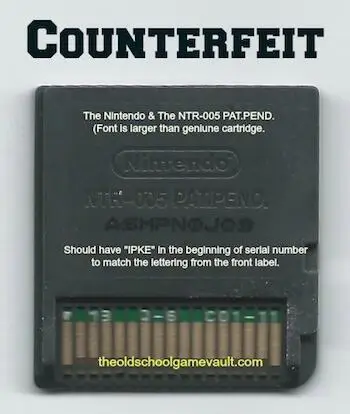
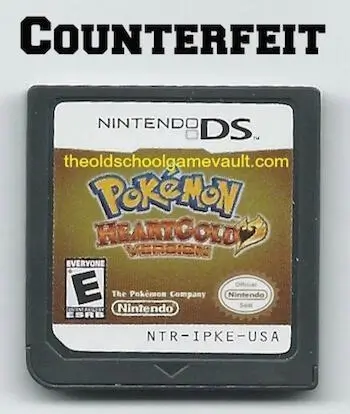
The biggest factor I found to determine counterfeit cartridges is the serial number. If you look on the bottom of the front label you will see some numbers such as [NTR-IPKE-USA]. The middle group of numbers [IPKE] needs to be a part of the serial number on the back of the cartridge. As you can see from the photo, this group of lettering is not a part of the serial numbers.

Upon inspecting approximately 12 other games

Each game had the second group of lettering, clearly part of the serial number, on the backside.  This is by far the quickest and easiest way to identifying fake cartridges.

How to Spot Counterfeit Pokémon Nintendo DS Games

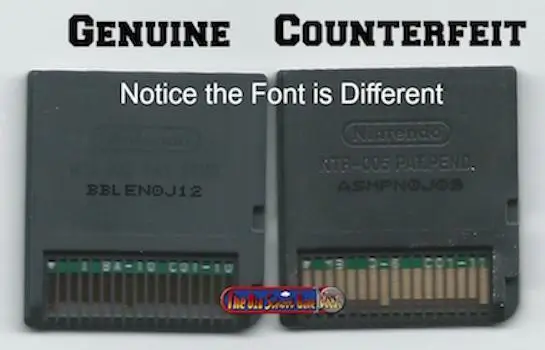
Step 2: The Font

The main noticeable difference is the font on the back of the cartridge. The Nintendo on the back of the cartridge is in a larger font than a “genuine Nintendo DS game”. Then if you look at the font for the model number & the [Pat. Pend.], it is the same similar larger font as the “Nintendo Lettering”. Refer to the photo below.

The font above the letter “E” on the front of the cartridge

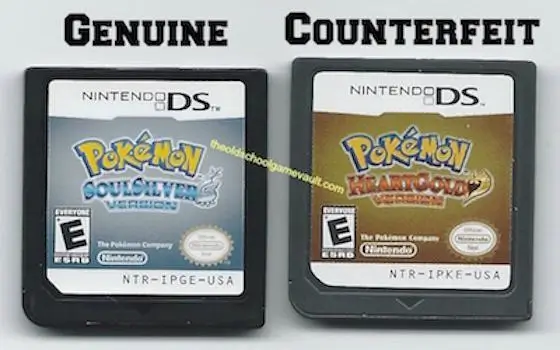
When compared to an authentic game. The wording “everyone” is much more legible on an authentic game. This also goes for the basic font on the front of the label. On the Legitimate game the font is much clearer and pronounced as you can see in the photo.

Step 2b: The Cartridge Color

When you look closer game to game, “BELOW” you’ll notice the games are different color’s.  You can notice a different in colors between the two games.  The color of the shell the on the Pokémon HeartGold Version in the photo is grayish. As the color should be black like the Authentic Pokémon Soul Silver cartridge in the photo.Genuine and Fake Pokemon DS Front Label Scan

Step 3: The Front Label

When you examine counterfeit copies & genuine games like the two games in the photo above. You can see that the bottom left corner of Soul Silver has a very distinct angle to it.  When you examine reproduction copies like the Pokémon HeartGold Version. You can see the bottom left corner of the label is rounded.

As I continue to do some research about the fake Pokémon Nintendo DS games.
I thought the game label would stand out, much like a counterfeit GBA game would. This doesn’t seem to be the case. The label on the front of the Pokémon game appears to have all the similar markings as a genuine Nintendo DS game. Except for the rounded bottom left corner on the Pokémon Heart Gold Version shown above.

Make sure to check out our other articles about the growing problem

And how to spot bootleg video games on other systems. Here are the other articles, hopefully you can find them useful.