I am glad I played 25 of my 50 playstation 5 games. I am glad I wrote 580 internet movie database reviews. I am glad I wrote 290 album reviews at Discogs since 2011. I am glad I was on bluray.com and had 1090 posts since 2011. I am glad I uploaded archive.org memories in 100 videos and 7000 JPEGs. I am glad I wrote 500 game reviews and 300 blog entries on my blog and gamespot blog. I am glad I wrote 100 book reviews at Goodreads and have 4900 friends. Now people can be friends with me or marry me someday.
Showing posts with label Linux. Show all posts
Showing posts with label Linux. Show all posts
Saturday, June 14, 2025

Friday, November 10, 2023
Reasons Why IT Professionals Are Quitting Their Jobs
Faced with the double whammy of a shortage of IT workers and a widening digital skills gap, it is critical for organizations to understand what motivates tech professionals and why they would choose to quit their jobs. New research from Jefferson Frank, an Amazon Web Services recruitment firm based in the U.K., finds numerous reasons why tech pros are quitting or planning to quit their jobs beyond a lack of salary increases
Why IT pros are quitting or wanting to leave their jobs
Based on this research, here are the top 10 reasons IT pros plan to change their employer within the next 12 months; the reasons are listed in order of how the answers were ranked:
- Lack of salary increase/earnings increase.
- Lack of career and promotional prospects.
- Need new challenges.
- Lack of leadership and vision.
- Working environment/company culture.
- I’m underutilized in my current role/company.
- Lack of exposure to the latest X products.
- To pursue a better work/life balance.
- I’m underappreciated in my current company.
- I’m over-stressed/overworked.
Fair compensation will always be critical, the report noted.
One surprise finding is that “57% of freelance AWS specialists would consider switching to a permanent role,” said James Lloyd-Townshend, chairman and chief executive officer of Jefferson Frank. “The world of contract work has previously been seen as such a lucrative ecosystem that leaving it behind seemed unthinkable. While those within it remain in huge demand, it’s interesting for those looking to attract professionals on a permanent basis that they are able to potentially hire from new talent pools.”
3 retention tips for tech leaders
Retention of IT staff is an issue that spans all positions and all industries, according to Lloyd-Townshend. Because tech professionals ” … have historically been in such high demand that if their current employer can’t offer what they want, there’s been a good chance someone else out there would be willing to,” Lloyd-Townshend told TechRepublic. “While that balance of power has evened itself up over the last 12 to 18 months, the culture of professionals not being afraid to move on to develop their career has remained.”
The other top reasons tech pros quit broadly fall into three categories: progression, purpose and working culture. Businesses will need to reinvigorate these elements in the hope of retaining their tech talent, the report said.
Retention tip #1: Provide career tracks
Tech professionals want clear pathways and career tracks to give them more incentive to stay with a business in the long term. This needs to include clarity around new responsibilities and initiatives at each stage to avoid any possibility of the work becoming too stale or employees feeling like they’re being underutilized, according to the report.
“Clear pathways are about being transparent on what a professional needs to take the next step in their career with you,” Lloyd-Townshend explained. “Rather than promotions being awarded without any clarity on the process, make sure people know exactly what’s required in order for them to progress.”
This might include experience in a specific area of that technology, or soft skills such as project management or presenting, he said. The important thing is knowing what’s required for employees to move up the ladder. This ” … gives you a far greater chance of a person taking those steps with you than trying to achieve their goals elsewhere,” Lloyd-Townshend said.
Retention tip #2: IT professionals want to be on the cutting edge
Organizational purpose has never been more important; professionals want to feel engaged and connected to what they’re doing. Ensuring your business is keeping up with developments in the space is essential, as tech professionals tend to want to be on the cutting edge.
Retention tip #3: Address well-being
Burnout remains a serious subject in tech, according to the study. A healthy workplace culture that considers work-life balance and stress levels must be fostered.
Lloyd-Townshend recommended making sure that ” … praise is visible across departments. A ‘well done’ email is always nice, but a shout-out during a larger call is better, as well as being able to explain to others how that person’s work matters as part of the bigger picture,” he said.
But this is something that must be embedded at the leadership level. A clear and well-communicated sense of purpose and company trajectory will radiate outward in a positive way for staff throughout a business.
These issues can’t be solved at the individual level, the study said; it requires ” … company-wide solutions that seek to prioritize well-being for its own sake rather than for purely utilitarian reasons, according to the report. Otherwise, ” … burnout will only continue to take people out of the sector.”
Additional steps companies can take
Jefferson Frank has seen companies offer volunteer days, which allow employees to take time off and contribute to local projects and causes, ” … giving them a feeling of purpose and that their company is helping them to do something that really matters,” Lloyd-Townshend said.
The process should start by listening to your staff, he said. “Your role as an employer isn’t to second guess what your employees need from you.” Leaders have a responsibility to find out, he added.
Methodology
The findings are based on 607 tech professionals working across AWS, Salesforce, Microsoft 365, Azure and business applications, as well as NetSuite. Jefferson Frank is part of the Tenth Revolution Group.
Monday, August 14, 2023
72% of Tech Workers May Quit Their Jobs. Fixing Organizational Cultures Can Help Them Stay Put.
We’ve known for a while now that there’s a tech talent shortage. Over a decade ago, more than half of CEOs expressed concern over the dearth of talent for digital roles. By 2019, 79% had concerns. The pandemic has severely exacerbated the issue and, to make matters worse, current tech workers are unhappy and fleeing their jobs. Seven in 10 tech workers say they’re considering quitting their jobs within the next year.
Employee expectations are high, and the performance gap is significant –just 1 in 4 knowledge workers strongly agree that their company exemplifies the factors they have identified as being important, such as well-being, employee experience, and values. The pandemic and the rise of remote work have changed the way we view our lives and the world. This has led to what organizational psychologist Anthony Klotz coined “The Great Resignation.”
The Great Resignation
In the U.S., the Labor Department revealed that 4.4 million Americans left their jobs in September 2021 – the highest number on record. The phenomenon is often associated with the United States; however, rates of resignation are high globally. In the U.K., the number of open jobs surpassed 1 million for the first time ever in August.
Generally speaking, it’s not uncommon for employees to leave their jobs in search of new opportunities. However, the technology industry is currently experiencing an acute form of disengagement. Staff turnover among U.S. tech companies ranks at 13.2%, which is the highest attrition index among all industries, with resignation rates increasing 4.5% over the previous year.
Poor Culture Leads to Unhappy Employees
For some workers, the pandemic has triggered a monumental shift in priorities. Many are now seeing the shift as encouragement to pursue a dream job or career or transition to a different style of work. However, for many workers who were already teetering on the edge pre-pandemic, poor cultures, work overload, lack of work-life balance, burnout, and lack of opportunity have pushed them to their breaking point.
Feeling undervalued
According to TalentLMS and Workable, a large number of tech employees say they feel undervalued and unappreciated when they’re at work and are looking for opportunities where they feel their work and input is respected. This issue is particularly evident in larger businesses, where there is a greater risk that employees could feel like small fish in a big pond, and where their individual efforts and achievements are more likely to go unnoticed.
Lack of career progression
About four in 10 IT, software, and tech workers have stated that limited career progression made them consider leaving their jobs. It’s easy to feel frustrated in a job if there’s little opportunity for promotion and career advancement. In order to develop and progress within their career, employees may seek out a different, more senior position at another company.
Rigid work structure
Flex-time and remote working are becoming increasingly popular ways to work. According to Gallup, 91% of workers in the U.S. working at least some of their hours remotely are hoping their ability to work at home persists after the pandemic; 54% of employees who work remotely at least some of the time say they would ideally like to split their time between working at home and in the office. People may look elsewhere for employment if their current job is not willing to be at least a little flexible on working arrangements.
Poor collaboration
Collaboration is at the heart of many critical business processes, especially as organizations grow more virtual and geographically spread out. If the experience of collaboration is challenging or counter-productive, this can affect morale and team cohesion. People often get stressed out when their tools or lack of teamwork can’t help them get their jobs done or meet their personal career goals.
Burnout
According to SHRM (Society for Human Resource Management), 48% of U.S. workers feel mentally and physically exhausted at the end of the workday, while another 41% report feeling burned out from their work. Overall mental health continues to get worse, with rates of anxiety, depression, stress, and post-traumatic stress disorder (PTSD) increasing dramatically. Citing heavier workloads, isolation, lack of work/life integration, longer working hours, and limited to no time off, tech employees are looking for new jobs and resigning from current ones in droves.
Toxic work environment
According to one study, working for a company that doesn’t value psychological well-being increases the risk of depression by 300%. Lack of recognition, favoritism, unhealthy communication, gossiping, and high turnover are a few issues that cause a toxic work culture. This can create conflict, low morale, excessive tension, negative results, illness, high turnover, and even abusive behavior amidst employees – contributing to employees quitting their jobs in search of a more positive environment.
Become a Culture of Choice
To attract and retain top tech talent in the era of the Great Resignation organizations will need to get creative – fast. What can you do to create a company culture that’s appealing to applicants but also keeps existing employees happy and engaged?
Here are a few key steps:
Be generous, and public, with your praise.
Oftentimes, employees only hear from leaders when something is wrong. This creates a distorted and negative perception of the value of their work and your leadership. Constructive criticism is important, but acknowledging a job well done is even more so as feeling undervalued is one of the top reasons for tech employees to quit, as noted above.
By publicly praising your teams, you’re creating a positive perception of their value to the organization and it establishes you as an empathetic and thoughtful leader. It will also encourage others to share praise rather than withhold it, creating a positive and collaborative work environment.
Become an ally and advocate for your team’s growth.
In a study by the University of Southern California, “Attracting and Retaining Talent: Improving the Impact of Workplace Mentorship” they identified several solutions to employee turnover, including career and professional development. With attrition rates above 13% in the tech sector, as a leader, it’s critical to develop a “mentorship” mentality, whether the objective is to develop emerging leaders, improve culture, or assist employees in meeting their career goals.
Be the person who collaborates with your team to eliminate obstacles and open doors. When they see you care about their continued growth and opportunity—even if that means they transition to a new department or assignment—they will feel valued and more likely to stay.
Be flexible.
1 in 3 tech workers say a lack of remote work options is a reason that would make them want to quit their job. Flexible leaders are able to change their plans to match the reality of the situation. As a result, they maintain productivity during transitions or periods of chaos. Being a flexible leader means recognizing that how and when your employees work best will vary depending on their individual circumstances. The important thing is that work gets done well – not that it gets done in a prescribed timeframe or environment.
In addition, being a flexible leader means surrounding yourself with a diversity of thought and people, as well as being open to embracing change and new ideas or concepts. Be flexible in your own leadership style to make everyone feel comfortable and able to contribute their best to the conversation or interaction. Have an open mind and focus on your core values. This will allow you to better understand the challenges of your teams, and propose solutions to meet changing needs.
Create space for teamwork and collaboration.
One of the biggest challenges facing the tech industry is cultivating a collaborative culture. A collaborative culture is based on openness, complete transparency, and building trust. As a leader, you must communicate your vision clearly and consistently while also making sure that your team is onboard. Share information openly, whether it’s positive or negative, and set realistic expectations so that your team members are aware of their roles in the bigger picture. Establish norms around communication, interaction, equality, problem-solving, conflict resolution, and decision making.
Teams also need to have the right technology and tools. Without that, collaborating with colleagues on the other side of the planet would be next to impossible. The right tools enable your teams to be more effective in their daily tasks while setting up a more transparent communication channel. It also gives everyone more visibility into projects and creates opportunities for people to work on the same task. Collaboration tools can help teams manage change, communicate, and save time while remaining productive.
Focus on employee well-being.
58% of tech workers have indicated that they’re suffering from burnout and those who suffer from burnout are twice as likely to quit their jobs than those who don’t. To help your team genuinely flourish, create conditions where two-way communication is frequent and candid. This means checking in with your team members early and often about their personal well-being, asking how they’re feeling about work and really listening to what they say.
It’s important to not just “talk the talk.” Actively model good behavior such as taking breaks, setting guardrails around emailing after working hours, and leaving the office or being offline. Remember to think, and talk, about well-being holistically, including financial security, career satisfaction, emotional health, and workplace relationships.
Eliminate toxicity.
39% of tech employees have cited toxic work environments as a reason for wanting to quit their jobs. Consistent bad behavior in a workplace isn’t just the result of a few “bad apples.” A toxic culture is inherently a management problem because it cannot co-exist in the presence of sound leadership. Failing to notice and act upon warning signs that something is wrong, or not fully appreciating how serious an offense may be leads to a harmful environment and high rates of attrition.
A people manager’s job is to lead a team in a way that creates sustainable business results. Creating or allowing a toxic workplace to form will do the opposite. As a leader, it’s important to become familiar with causes of tension or dysfunction in the workplace, take employees’ concerns seriously, and understand your role in helping to mitigate toxicity when it occurs and re-establish a sense of safety.
Leading with Empathy
The pandemic transformed the way we work and employees have more choices than ever before. Pay and benefits are no longer enough. 52% of workers say they would quit their job –and only 1 in 4 workers would accept one –if company values do not align with personal values, and that begins with culture. Although the competition is fierce for qualified tech talent, organizations must start laying the groundwork now to keep their candidate pipeline full. Leading with empathy means understanding your employees’ feelings, thoughts, and emotions.
Being an empathetic leader allows you to connect with your team through vulnerability while assuring them that you are on top of the situation and capable of making good decisions that will benefit them and the business. Conveying a “we’re in this together” attitude, while being empathetic and vulnerable, allows your teams to model your behavior, helping to create a positive, open, and honest culture where teams feel engaged and valued.
By building a culture built on empathy and compassion, you’re signaling that your organization understands the factors and motivations that drive an employee’s choice to stay or go.
Big problem – why half of tech workers are planning to quit their job due to toxic workplace culture
Since the start of 2022, more than 1,700 tech companies have laid off staff, leading to over 350,000 people losing their jobs. As well as the impact on the individuals being let go, this current trend is intensifying a climate of toxicity in technology companies.
That’s according to research from TalentLMS and Culture Amp, which found that 45% of employees working in tech firms with a toxic culture said the layoffs have resulted in a worse atmosphere at work. Of the 1,000 tech workers surveyed, 45% are planning to quit their job because of this toxicity.
According to Christina Gialleli, Director of People Operations at TalentLMS parent company Epignosis, as tech job losses increase, so does the pressure:
We’re going through difficult times here. I don’t think most companies have completed their layoffs. We’re still in turmoil, and we get to see the outcome of this in this pressure.
When it comes to who is responsible for creating a toxic culture at their workplace, 55% said leadership and managers, while 31% said colleagues. The top three contributing factors are expecting employees to work longer hours or weekends without additional pay; a lack of transparency and communication from management and leadership; and a lack of consideration and courtesy.
The combination of pressure from leadership and senior management, companies not wanting to hinder productivity, and people not speaking up because they’re afraid of the consequences are all leading to this worsening atmosphere at tech companies. Gialleli says:
If the employees are being pitted against each other, if the companies are promoting unhealthy competition, if toxicity is tolerated rather than sacrificing the high performer who’s toxic, that’s going to spread to the team. And a toxic team is going to be toxic to other teams and it will cascade down and escalate, and then your people end up leaving.
This latter point is borne out by the almost half of staff planning to quit their current job, a situation that could cause difficulties among tech companies being complacent about employee retention during a period of industry job losses.
Attitude problem
There’s a danger companies are taking the view that with so many tech workers available, it doesn’t matter how they treat staff because they can just be replaced if they leave. However, the tech sector is still in the midst of talent shortages, meaning companies need to take measures now to address the toxicity and retain their best people. Gialleli says:
The tech sector was struggling [with skills shortages] for so many years and now it’s seeing talent becoming available again, but this is going to be short term. You have to have a zero tolerance policy. You need to make your leadership team accountable for addressing it.
Workplace training in areas like DEI, empathy and discrimination can help in fostering a positive and healthy work environment. Firms need to ensure employees understand how to behave and work within their teams, and how to address issues when they arise, whether it’s regarding a colleague, their manager or manager’s manager. Gialleli adds:
You need to create a transparent environment where people are not afraid to speak up, know what to expect, how to behave, how to address situations, and know that the company is going to do something about it.
This isn’t the case presently. Half of employees don’t do or say anything when they experience toxic behaviours at work – 29% because they don’t believe it will make a difference and 20% because they’re too nervous about the consequences. Meanwhile, 45% of employees say that leadership at their organization lives in a bubble that company culture is healthy.
According to Gialleli, buy-in from the CEO is vital to deal with these issues, although HR has a role to play too:
The HR teams are facilitators, they can roll out surveys to figure out and pinpoint the issues, and then they can address and create in collaboration with managers and the leadership team the appropriate training that will help rectify the problems. But this is all top down.
Almost half of workers currently believe their companies will remain toxic in the future, which brings risks for their employers:
People are affected by working at a toxic environment. It affects their productivity, it affects their mental health, and ultimately people that are unhappy are going to leave. The bottom line is retention and productivity and being able to have performing teams. That’s what you’re going to have if you address it and you have everything to lose if you don’t.
Good people are not going to stay in a toxic environment. Companies may be able to fill their hiring quota, but it costs to replace people, it costs to train them and to find good people. Maybe it’s easier than it was a year ago, but you still need to lay the foundations and make sure your people are happy and productive.”
My take
The findings of TalentLMS’ research seem
at odds with the increasing focus on diversity, equality and inclusion
(DEI) at so many tech companies. According to the 2022 KPMG DEI Progress Survey,
71% of firms reported having taken many DEI-related actions since 2020.
Surely a core element of any DEI efforts would be creating a welcoming
and inclusive environment for all – the opposite of a toxic culture.
While the tech sector is clearly focused on surviving the current
hard times – hence the huge raft of job losses and more pressured
environment for staff – this short-termism will backfire when the
economy picks up again. Those 55% of tech staff working in a toxic
culture but not planning to quit their job are much less likely to hang
around once stability returns and vacancies rise.
Sunday, January 15, 2023
The new labor market: No bachelor’s required?
Groom, who was once enrolled at Bowie State University, left college when his first daughter was born. That daughter now has a college diploma. Groom still does not. But he had gained experience and credentials: a two-decade rise in retail from Giant cashier to CVS store manager, and a suite of computer networking certificates that led him to three years of information technology contracting gigs.
When Groom interviewed for his first IT job, he heard the dispiriting sentence that trips up so many careers: “I’m looking for someone with a bachelor’s degree.” But the hiring manager at that job looked past the unchecked box, and took Groom on as a configuration management analyst.
“Certificates are huge in IT. A certificate will get you in the door. But if you’re gonna go anywhere, you need that [B.A.] in addition.”
Amber Wallace Dekie, help desk professional
That was one position, and one hiring manager. Who knew what would happen with the next job search? With Hogan’s move, however, the lack of a degree was no longer an obstacle, at least for state jobs: It was a reason to be recruited.
“It means a lot,” Groom said of Hogan’s announcement. “There are a lot of companies limiting out a lot of talent. You can have a degree and not have the knowledge and skill sets.”
He followed a link to a job site called Stellarworx and applied for two IT positions with the state.
Related: What if we hired for skills not degrees?
Thanks to a tight labor market, more good jobs are opening up to workers who lack a bachelor’s degree. A month after Maryland’s announcement, Colorado Gov. Jared Polis directed government agencies in his state to embrace hiring workers for skills, not degrees. Private sector employers have been rolling back B.A. requirements too.
While the pandemic labor shortage has prompted more employers to welcome applications from workers without degrees, workforce advocates have been pushing back for years against a surge of so-called degree inflation triggered by the Great Recession. When the economy tanked in 2008 and millions of laid-off workers began competing for scarce jobs, employers got pickier about who they hired and increasingly added four-year degree requirements to some “middle-skills” jobs that had frequently been filled by workers without degrees. (Middle-skills jobs, which include positions in fields such as health care, IT, and sales, require some training or education beyond high school, although not necessarily a B.A. — jobs like registered nurse, human resources assistant, or help desk technician.) Even before Covid hit, advocates for accepting applicants who lack a college degree had found some success persuading employers that it is in their interest, no matter the labor market, to hire workers who have skills but lack a bachelor’s degree.
The Google campus in Mountain View, California. The company is one of many that’s dropping bachelor’s degree requirements for certain jobs. Credit: Justin Sullivan/Getty Images
The increasing availability of good jobs for those without degrees coincides with a growing struggle for postsecondary education. Enrollment, already on a decade-long decline, dropped precipitously during the pandemic, emptying a million seats at two-year and four-year colleges. This convergence — fewer people pursuing diplomas, and more being recruited without one — raises the prospect of young workers putting less stock in obtaining a bachelor’s degree, for so long an unshakable aspiration for Americans of every background.
The lack of the credential has traditionally shut workers out of their desired professions and the wealth accumulation that comes with them. Sixty-two percent of Americans over 25 have no bachelor’s degree, and that number rises to 72 percent for Black adults and 79 percent for Hispanic adults. Any shift in the workforce to the advantage of workers without degrees carries obvious implications for economic mobility and equity.
However wide the door opens for workers without degrees, they won’t get through it without sufficient skills. Their success in the labor market depends upon finding an affordable pathway to develop those skills and the willingness of employers to keep prioritizing skills over degrees, even if a recession upends the job market.
Some workforce observers see reasons to believe employers will keep that door open for workers without degrees, even if the economy sends more college graduates their way.
Related: More students question college, putting counselors in a fresh quandary
When the Hogan administration heard how hard it was becoming for agencies to fill open positions, it partnered with a nonprofit organization called Opportunity@Work to recruit workers like Groom. Opportunity@Work calls such workers “STARs,” because they are Skilled Through Alternative Routes, like workforce training, community college courses and job experience.
Opportunity@Work connects STARs to training programs and works with employers to develop job listings for its Stellarworx employment website. The organization claims 70 million Americans are STARs. Maryland labor secretary Tiffany Robinson estimated that 47 percent of Maryland workers are, too.
“We had a flood of applications on the first tranche of postings,” Robinson said. She estimated that more than half of the state government’s 38,000 jobs could eventually substitute experience for a four-year degree.
Businesses like Google, IBM, and Accenture have also made high-profile moves to boost skills-based hiring and remove bachelor’s degree requirements. In a report on the “emerging degree reset” released earlier this year, the labor analytics firm Burning Glass found that just 9 percent of Accenture’s “computer support specialist” listings required a bachelor’s in 2021, down from 46 percent in 2017.
“The sad truth is, when you filter candidates based on college degrees, you’re closing out the vast majority of Black and Latino talent in the country.”
Merit America co-CEO Rebecca Taber Staehelin
During the pandemic, employers ditched degree requirements at an even faster pace. In January, the Federal Reserve Bank of Philadelphia examined a subset of middle-skill jobs and found that the proportion of job listings asking for a college degree dropped 4 percent between the first quarter of 2020 and the second quarter of 2021. In the Philly Fed’s estimation, that means 700,000 more of what it calls “opportunity jobs” — positions open to those lacking degrees that pay more than the U.S. yearly median of $36,660.
Employers could slap bachelor’s requirements on these kinds of listings again, if job seekers come flooding back. But Joseph Fuller, a professor of management at Harvard Business School, believes many of them likely won’t.
The Burning Glass “degree reset” report, which Fuller co-wrote, found that between 2017 and 2019, the number of positions requiring a B.A. dropped by more than 5 percent in roughly half of all middle-skills occupations. Though the labor market was already tightening, the report found that only a quarter of these changes were “cyclical,” or attributable to the labor market. Sixty-three percent of the changes were deemed “potentially permanent” shifts in hiring practices.
The trend toward degree inflation, the report concluded, has been reversed. If it sticks, Fuller and his co-authors believe 1.4 million more jobs could become available to workers lacking a B.A. between now and 2027.
Related: Long disparaged, education for the skilled trades is slowly coming into fashion
Although degree requirements may disappear for many jobs, workers will still need some alternative way to build the skills required to get hired without a college degree, whether through workforce training, on-the-job experience, or the kind of short-term education and certifications provided by community colleges and other institutions. Many job seekers never get the chance to access these pathways because they are stuck in low-wage, low-skill jobs and, as Fuller put it, “can’t afford not to work.”
“They’re inhibited to seek training because they can’t give up what they’re doing now,” Fuller said.
Fuller points to the work of Social Finance, a nonprofit funded by “impact investors” that helps workers train without going under financially. Social Finance provides wraparound services such as an emergency aid fund for child care, rent or transportation. Workers pay back the cost of their training only when they reach a certain salary level.
In February, Google announced a $100 million partnership with Social Finance to help as many as 20,000 workers earn IT certificates. Social Finance will draw on nonprofit workforce groups such as YearUp and Merit America to train participants and counsel them toward employment. Merit America co-CEO Rebecca Taber Staehelin said these kinds of programs can help companies walk the walk after years of talk about diversity, equity and inclusion.
“The sad truth is, when you filter candidates based on college degrees, you’re closing out the vast majority of Black and Latino talent in the country,” Taber Staehelin said.
Related: More people with bachelor’s degrees go back to school to learn skilled trades
Halid Hamadi, a 28-year-old Washington, D.C., resident, stumbled upon a Merit America IT training program on Indeed.com. “I was like, ‘Okay, that’s too good to be true,’” he said. “Because in bold they said, ‘We’re looking for minorities that don’t have a bachelor’s degree.”
A Google IT certification helped Halid Hamadi, 28, jump from minimum wage work at a Nike store to a $45,000 help desk job. Credit: Image by Anne Giebel, provided by Merit America
Hamadi had withdrawn from Penn State University in 2016 for financial reasons and taken a minimum wage retail job back home in Montgomery County, Maryland. Merit America provided a stipend that helped him afford a bus pass to attend job counseling sessions while he completed a 13-week Coursera program to earn a Google IT certification. His first job was a $45,000 “tier one” tech support position with a health care software developer. Two promotions later, he was an integration engineer making $75,000.
Another Merit America participant, 32-year-old Amber Wallace Dekie of Manassas, Virginia, graduated from high school in 2008, just in time to hear the housing bubble pop. She chose a comparatively recession-resistant industry to work in: health care.
“I realized I’d find more work; it felt like there was job security in it,” she said. “I found out later they don’t pay very well — the lower-level jobs, at least.”
She worked as a nurse’s aide, clinical technician and pharmacy assistant, never earning more than $14 per hour. Then her boyfriend landed a good IT job, and she started looking for her own. Like Hamadi, she stumbled onto Merit America’s program browsing IT listings on Indeed.com, applied, and completed the training. With her new Google certification, she went to Stellarworx and found a $22-per-hour help desk job.
Related: More people with bachelor’s degrees go back to school to learn skilled trades
A bachelor’s degree still holds prestige as a ticket to the middle class, but its value has received increasing scrutiny. In the last several years, rising tuition has been reason enough to reconsider an investment in postsecondary education: Americans owe more than $1.7 trillion in student loans. When Gallup asked Americans in 2019 about the value of college degrees, just 51 percent answered “very important,” down from 70 percent in 2013. The pandemic has driven down four-year college enrollment by 4 percent and community college enrollment by 17 percent since spring 2020.
Whether even more Americans opt out of four-year college will depend in part on the quality of jobs available without that diploma. Anthony Carnevale, director of Georgetown University’s Center on Education and the Workforce, said that a decade from now, 4 out of 10 jobs will be reserved for people with at least a bachelor’s degree, and 3 out of 10 for people who lack the degree but do have some training or postsecondary education.
“Where the rubber hits the road is: Are they good jobs or not?” said Carnevale. For four-year degree holders, 75 percent of jobs will be good — which he defined as paying at least $40,000 per year by the time the worker reaches age 40. For those with no bachelor’s degree but more than a high school diploma, the share of good jobs drops to 40 percent. In other words, not everyone without a B.A. will be able to land a good job.
But, Carnevale said, “If you’re careful and make good choices, you don’t need a B.A.”
On Capitol Hill, where lawmakers are worrying about America’s competitiveness, Carnevale perceives a turn from higher education to workforce training. One bill currently in conference committee would make some short-term training programs eligible for federal Pell Grant funding, as long as their graduates demonstrate a 20 percent wage increase.
“The communities that don’t have the college background, they still want that for their kids. They’ve been told that’s the American dream.”
Maureen Ponce, president-elect of the Maryland School Counselor Association
Still, the workers most likely to thrive, Carnevale said, will have accumulated both the general education and flexibility that come with a bachelor’s coupled withsome specialized training. Specialization alone can pay off in the short-term: Carnevale said that 30 percent of two-year degree holders earn more than those with four-year degrees. But a bachelor’s degree still pays off in the long run through a significant advantage in lifetime earnings.
“The American B.A. is superior in the postindustrial world, and the reason appears to be that it makes people more adaptable over time. In 20 to 30 years, there’s something of a recovery in terms of earnings power,” Carnevale said.
In other words, a B.A. in, say, the humanities might get workers off to a slow start. “But a substantial share [of workers] 20 years out will be fine,” Carnevale said. “If you get a certificate in HVAC, 20 years out you’ll fall back in the pack.”
Even if more young people recognize the short-term gains they can make by plunging into the workforce without a college degree, that degree has retained its potency as a symbol of economic advancement. “I can’t tell you there’s one student I’ve ever talked to that said, ‘What’s the point of getting a college degree?’” said Maureen Ponce, president-elect of the Maryland School Counselor Association. “I’m Latina. For Latino families, it’s about, ‘I never had a chance to get a college degree. If my kids can get one, they’re gonna get one.’”
Counselors like Ponce work under the banner of “college and career readiness,” but any focus on career at the expense of college still gets pushback from families — and not just from wealthy families with Ivy League dreams.
“The communities that don’t have the college background, they still want that for their kids,” Ponce said. “They’ve been told that’s the American dream.”
Related: Debt without degree: The human cost of college that becomes ‘purgatory’
More workers may be accessing skills and finding good jobs without degrees, but not all of them have foreclosed on the idea of returning to school. Some, like Virginia resident and Merit America alumnus Wallace Dekie, worry they’ll hit a career ceiling without a college diploma, despite the gains they’ve made with alternative qualifications. Wallace Dekie knows the benefits of training — after moving into IT and developing specialized skills, she makes twice what she made as a nurse’s aide seven years ago — but she understands the power of the four-year degree.
“Certificates are huge in IT. A certificate will get you in the door. But if you’re gonna go anywhere, you need that [B.A.] in addition,” she said.
Previously stuck in low-wage jobs, 32-year-old Amber Wallace Dekie of Manassas, Virginia, jumped from health care to IT and nearly doubled her salary after workforce advocates helped her get a Google certification. Credit: Courtesy of Amber Wallace Dekie
She’s currently looking into an online bachelor’s program at Western Governors University, an online-only private institution.
The strategy of earning certificates in the IT field has also worked out well so far for Groom, the former cashier, even if it depended on the good luck of having a hiring manager who looked past his lack of a college diploma. Groom has already earned six figures in one year. The Hogan administration’s move to hire for skills rather than degrees has opened another potential career path for him, and he hopes landing an IT job with the government will give him an entrée to a career in cyber security.
Thursday, November 25, 2021
7 in 10 tech workers say they're considering quitting their job within the next year in a new survey
- Seven in 10 tech workers are considering quitting in the next year, per a new survey of 1,200 people.
- Their top reasons included working hours, limited career progression, and toxic work environments.
- The labor shortage continues to cause havoc across multiple industries.
Seventy-two percent of US tech workers are considering quitting their jobs in the next 12 months, according to a new survey from learning software firm TalentLMS and Workable.
About four in ten of the 1,200 IT, software, and tech workers surveyed said that limited career progression made them think about leaving their jobs.
Other common reasons for considering leaving included non-flexible working hours, feeling underappreciated, and toxic work environments.
Just under a third of respondents said a lack of remote working options was making them consider quitting, too.
Eighty-five percent of respondents said that they felt their company focused more on attracting new employees than investing in existing staff. They said that more training and learning would make them feel more motivated, and that so would greater flexibility in where and when they worked.
Another 58% of all respondents said they were suffering from job burnout, though only 30% of those thinking of quitting cited burnout as a top reason why.
The US is suffering from a huge labor shortage, catalyzed by the pandemic, and people are reassessing what they want from work.
This has fueled the "Great Resignation," with record numbers of people quitting their jobs. Some are returning to education, while others are swapping industries or going freelance.
A separate survey by Joblist found that 73% of Americans were considering quitting their job, with more than a quarter of these people saying they would feel comfortable quitting their job without a new one lined up.
The labor shortage has hit industries ranging from education and healthcare to trucking and restaurants.
To plug their labor shortage, some companies have hiked up wages and started offering hiring bonuses.
Some chip companies, including Intel, are even hiring students who are still in college to plug a labor shortage amid surging demand for semiconductors.
Here’s the why:
- Relentless employer demands
- Continual interruptions and disruptions to work-life balance
- Ill-defined projects
- “a steady stream of half-baked requests from stakeholders”
All of these elements contribute engineers’ dissatisfaction and yet, if the median annual wage for engineers is $91,000, which is substantially higher than the average American income, how bad could it be? Shouldn’t we just say “toughen up cupcake”?
It’s worse than we thought…
Of the 600 data engineers surveyed, 78% stated that they wished the job “came with a therapist” to help with stress management. Nearly 80% of respondents stated that they were considering a move to a different career altogether. The researchers who conducted the survey warned that burnout must become “every organization’s top priority” in order to retain top talent for the long-term.
Saturday, November 07, 2020
Why are careers in information technology unfulfilling?
I hate working in tech
I know this may sound dramatic, but it’s true. I hate working in tech. While the tech world seems to be a boundless, relatively uncharted territory for creation and problem-solving, my personal experience working within it led to see that it is almost the exact opposite. IT lacks the freedom and sociability I crave. The framework most developers are forced to work within is highly limited and impersonal. While having to perform highly robotic and mind numbing functions for the bulk of the work day, I found myself losing sight and understanding of basic human qualities and how to think more creatively.
Not only that, the majority of my challenges were caused by the fact that tech is constantly breaking and/or versioning. The smallest thing can be coded incorrectly or be out-of-date, and the entire system will breakdown. Having to identify the error and provide solutions to a group of people who for the most part have no foundational knowledge of IT is very labor intensive, stress inducing and serve a major time suck.
What does an information technology person do?
As the U.S. and the rest of the world become more reliant on a digital economy, there is an increasing demand for talent that specializes in technology. Despite these radical changes in the way the world operates, many people in tech have a way less glamorous life while working to support these technological efforts. They would not consider themselves a part of the lofty “innovation sector” that I was once very attracted to. Rather your average IT person is thinking in basic 0’s and 1’s and trying to help anachronistic systems communicate better and more efficiently.
These roles could fall into any of the following categories: software development, computer system analysis, IT security, web development, network architecture, IT management, database administration and support. While there are a few other categories that exist, much of the foundation of these jobs are built on what I’d call “basic computing” functions which in my opinion can be pretty boring stuff.
Information Technology isn't about people
The large majority of us humans feed on the enthusiasm and interaction with people. Even the most introverted among us need people in our lives to feel like we're connected. People enable very organic relationships that most of us intuitively understand. With people, we aren't dealing with the 1s and 0s of computer languages where every damn decision is computationally determined based on a series of predetermined variables that aren't governed by emotion or external factors. Computers aren't organic.
Careers in information technology and software development are about systems, not people. We work with inanimate objects. Machines. We don't get to converse with them and establish relationships like we do with people. It's just code, or hardware, or networks, or machinery. So impersonal.We don't get to "change a computer's life" like we could with another human being.
Connections like those simply do not exist in technology very often, and that absence of an organic relationship while working at various tech companies can, over time, begin to drain our sense of purpose. All we do is work with machines. Dumb terminals. And at the most basic level, they are all pretty much exactly the same. Over time, this becomes relentlessly tedious.

Information Technology is full of stress and pressure
Technology is everywhere. We depend on it in virtually every facet of our lives, and when it works, it's great. Everything seems to be tied into "the system". All things are connected. Cities can monitor every stop light through a series of cameras accessed from a central location. Internet providers can pinpoint sources of congestion and bottlenecks through sophisticated network monitoring apps. Schools uses technology to connect students to the world outside. Businesses rely on technology for their livelihoods.
When everything works, life is good. But, almost nothing always works in information technology. Tech systems are connected in weird and complicated ways. Variables change. Insanely tight deadlines encourage even the most knowledgeable or talented software engineer to cut corners. And, people interact with systems in ways that we didn't (or couldn't) anticipate. In some cases, hackers and other nefarious entities intentionally screw with the systems that we've put together. In other words, things go wrong...all the time.
Here's the larger problem: When our entire world runs on the collective hum of technology, problems are instantly magnified. Businesses lose money every second that the network is down (imagine if Visa couldn't process credit card transactions for 10 minutes - they'd lose millions). What if stop lights in your city suddenly went dark? Or the power grid collapses?
Technology problems have profound consequences, and those who work in information technology feel that pressure. Pressure leads to stress, and that stress builds over time. It becomes a nearly constant strain on our lives. And, those of us who work in tech support or have program management jobs feel it the most. Managers want to look good by keeping their systems operational and often put pressure on their staff to do whatever it takes to keep everything humming along.
We might be able to keep up with this pressure for a few years after landing a new job. Eventually, the pressure of technology begins to break us down. We fix one problem only so we can move on to another. Problem after problem, we keep churning through "the system", fixing this, enhancing that, developing a new cool feature that we hope never breaks. And around and around we go.

Tech salaries keep the golden handcuffs cinched tight
If information technology is so unfulfilling, why do so many people work those jobs? We work them primarily for the money. Tech jobs pay well. In fact, they have to pay well or most of us simply wouldn't do them.
We use those higher salaries to help ignore the stress of the job. We buy things to make us feel better and relax. Our expectations change over the years and we soon begin to depend on that money to fund our lifestyles that become more and more expensive as we earn more and more money.
The golden handcuffs keep us working stressful IT jobs because the alternatives seem dire. If we bring in $150,000 a year working a highly stressful tech job at Amazon, there aren't many who would entertain a $75,000 accounting job at a local firm, even if that job is far less stressful.
We want the money, and our careers in technology keep us wanting that money. It happened to me. It happens to a lot of us.
The longer we work unfulfilling jobs, the more frustrated we become. Until, one day, something finally breaks and we just can't take it any longer. We decide on another path. Maybe a different career. Or, at least in my case, that path was early retirement from full-time work.
Technology jobs can suck because...
It comes down to three primary factors: Technology jobs are about machines, not people. Those jobs are typically highly stressful and pressure-packed because our entire society relies on those systems working harmoniously together. And lastly, money keeps so many of us working jobs that we don't enjoy. Pulling the plug on lucrative careers can be tough.
Too tough for many of us.
Sometimes, society can dismiss a lot of early retirement talk by chalking it up to highly paid tech workers. "So, Steve made a ton of money in technology and then retired early? Yeah, just like every other early retiree. Go figure!"
The reality is it's a lot harder to escape highly paid jobs than people realize. After all, this is what we've all worked so hard to achieve. We all want a high paying job, right? Once we have them, it's tough to give them up!
All that work we put into getting our college degrees (and racking up student loans), reading books, working incredibly long hours, putting up with insanely complicated layers of management that expect miracles...all that finally comes together into a highly-paid job that probably comes attached with "success".
To give all that up - even with a lot of money in the bank, isn't easy. Though high incomes can make it easier to retire early, they also make it tougher for many of us to stomach the stark difference in cash flow. To go from $150 Gs a year to zero (minus capital gains, of course)?
Don't take that for granted. Believe it or not, it's much easier said than done.
Why I left information technology
To further substantiate why I want to leave the world of tech, I’d like to share more in my experience and the positive upshots of my vocational departure.
First, I was experiencing an overwhelming amount of stress for the majority of my waking life. My day-to-day was spent fighting a multitude of uphill battles where I was committed to insane deadlines to fix or troubleshoot problems that affected tons and tons of people. It’s nice not having that kind of pressure anymore.
My work-life balance was also very much partial towards the work side of the paradox. I wanted to be able to focus on activities I actually enjoyed doing like exploring nature and photography, and be able to spend more time with my family.
And lastly, the subject matter of my work became extremely drab. I was no longer excited by 0s and 1s. I wanted to free myself to explore ideas and concepts that were not bound purely to binary systems. I can now think more out-of-the-box as I am less confined to a prescriptive set of code.
Thursday, May 28, 2020
Why Everyone Hates IT People
Quick: what’s the biggest bottleneck in your company? Yup, we both
know it’s the Information Technology department. Let’s face it, nobody
likes IT people. For all of their technical wizardry, IT is where good
ideas go to die. We follow their onerous documentation requirements and
patiently wait in line through endless backlogs, yet somehow IT still
can’t seem to get their work done.
Hating the IT department is a common sentiment in almost every company big enough to have such a group. But the truth is, it’s not the IT people’s faults. In fact, a despised IT department is a symptom of a CEO who doesn’t understand psychology. It is a corporate dysfunction for which management, more than anyone else in the organization, is responsible.
TO CREATE IS HUMAN, TO IMPLEMENT DIVINE
Why does the IT department drive everyone nuts? The answer lies deep in our primal need to contribute to our tribe. As Logan, King, and Fischer-Wright pointed out, the workplace is our modern-day clan. We come to the office with the same mental hardwiring we acquired 200,000 years ago when our species emerged. Back then, tribes with individuals creative enough to make new discoveries survived better than less innovative groups. Today, our workplace is our tribe and our impulse to create is no less important. Evolution gave us the mental machinery to seek to improve the welfare of our social groups through discoveries made by each individual.
When creativity is stifled, we become frustrated, unfulfilled and complacent. Unfortunately, in most organizations, workers blame the most obvious bottleneck, hence, they point the finger at the IT department.
In actuality, the complaints are a result of a broken feedback loop and the discontent can be explained by unraveling the blockages to corporate innovation. Though I have written extensively about how feedback loops and desire engines can be used to design behaviors, the inverse, breaking the reinforcement cycle, can bring the urge to innovate to a grinding halt, and that’s exactly what explains anti-IT-ism.A BROKEN LOOP
Employees today are inundated with messages from management to “be innovative,” “think outside the box,” “spot good ideas when they see them,” and most of all “get stuff done.” Business books and gurus extol the value of innovation and spread the message that only companies who quickly change with the times have a hope of survival. The message to employees is “if you contribute innovative ideas, good things will happen to you and your tribe.”
These messages constitute the cue or stimulus phase of a reinforcement loop. Originally studied by B.F. Skinner over 60 years ago, reinforcement remains a powerful basis by which we learn how to behave. In a successful reinforcement loop, the cue is followed by an action, which then brings a reward. Unfortunately, in most companies, when employees generate good ideas, no reward comes, projects lag, and innovation stalls.
If employees do not receive positive reinforcement for their efforts, or even worse, are forced to comply with endless documentation requirements, long development cycles, and corporate politicking, their natural instinct to contribute shrivels. Creativity soon morphs into dysfunction.
WHERE INNOVATION DIES
It begins with a management team woefully unaware the process is broken. Next, non-technical staff, unable to produce quality output, learn to shirk responsibility as they throw projects over the fence to IT. Unwilling to place blame on management, business staff point the finger at IT ranting about why a project is late, again. Employees begin to see the company not as one, but two tribes. The business people are seen as those charged with generating ideas while the engineers are the methodical implementors, cranking out instructions verbatim.
Everyone suffers from this scenario as members of the IT department are held hostage by endless product backlogs, leaving little room to contribute their own creative wisdom. When faced with a long list of tasks and the manic pressure to complete every request urgently, engineers find themselves plugging away instead of taking the time to understand what’s truly important to the business. This endless, and often mindless, drive to complete the next item on the list isolates engineers from customer-facing employees who could help them better understand what the product actually needs to do for the user. Business people view engineers as lazy code monkeys and engineers view business people as unskilled taskmasters. This familiar pattern perpetuates in-fighting and destroys creativity and initiative.
There are various methodologies for building better technology and companies have experimented with skunk works, incubators, 20 percent time, cross-functional teams, and even software “SWAT teams.” In future posts, I’ll dive into what organizations can do to bring innovation back and help the IT department feel loved again--stay tuned here and subscribe on my blog.
Above all, management must ensure employees are rewarded for their attempts to improve the company. While the reward of social recognition or monetary incentives is nice, often the satisfaction of simply knowing the idea was implemented is sufficient to fulfill our human need to contribute. When good ideas languish in bureaucracy, the feedback loop stops, and so does innovation.
Saturday, May 09, 2020
Why Linux is better then Windows and Mac OS X from my experience
I want to say Linux reigns supreme over Windows XP, Windows Vista, Windows 7, Windows 8.1, Mac OS 10.9 and FreeBSD. I had Debian in high school Linux +. RHEL in 2004, OpenSUSE in 12th grade. Then I was introduced to Knoppix in 2005 Linux+. Ubuntu in 2007, Fedora in 2008 Linux+, Cent OS from 2012. FreeBSD in 2012. In the beginning with Windows XP, I dual booted Debian with Windows. Windows blue screen of death crashed and then I used the NTFS-3g driver to get stuff off Windows in Linux until 2010. I stored my MP3s on a “MP3” partition I used with Partition Magic and later G-Parted so I wouldn’t lose that partition. In 2013, I changed the mp3 partition from a NTFS file system to EXT4 file system. I kept my mp3s and photos on DVDR so I could retrieve all of them after my operating system crashed or my hard drive was fried.tu Beginning in 2014, I realized that an old Ubuntu OS can survive six years with some kernel updates and that I wouldn’t lose my mp3s on the EXT4 partition, because my computer was just like a old Apache web server! The Only other OS that lasted from 2015 since Mac OS X 10.9 where the hard drive says I used for 2 months total uptime and 500 starts. My Linux I used from 2014 says the hard drive was used for 1 year 10 uptime and 4442 startups. In the linux, the sometimes file manager crashed, but not the OS. Windows XP, Windows Vista Windows 7, Windows 8.1 would freeze up completely after 18 hours. I used stream ripper to stream Shoutcast onto the hard drive in Windows where after 18 hours, Windows XP or Windows Vista would have a frozen screen. I don’t get viruses in Linux. I don’t get Trojans in Linux. I remember getting viruses or Trojans on Windows and having to reformat the hard drive, reinstall apps, and mp3 files totaling 6 hours. Windows sometimes installs viruses with Windows updates. Windows 10 does timentry while linux doesn't. I had virtual machines in 2012, but sometimes the save state of the images failed and the operating system on that image cold booted. I still wanted windows to play Windows PC games so I kept it updated to Windows 10. Windows 10 has Windows explorer crash. Windows 8.1 always seemed to freeze from PC Games and Youtube videos! Windows 10 isn't that stable. There's a reason why hospitals are using Windows 7 and Windows XP. When you repair Windows 10, the Windows Update takes 12 hours during the re-install. This software for my Linux called PlayonLinux installs a lot PC games from the 2000s. My 8-core Intel Mac with Mac OS 10.9 became a photography, retro videogame emulator and mp3 storage. I wanted a iphone since 2015, because then I have imessage, and 5 years of OS updates. I got an ipad, because I thought it was going to be a Nintendo 3DS like with mobile games. I played Poker, Solitaire, Super Mario Run, Mario Kart Tour and Pokemon Go on the ipad so far. PC-BSD 10 worked great, had OS stability, but the files were obsolete within months and no updates. Android phones slows down or have performance problems after 2 years. I had experience with FreeBSD 8.2 to FreeBSD 12.1. Then PC-BSD only had months before the upload respiratory with the current latest software version was broken with my operating system. Linux updates its repositories for 4 years, then you can update Firefox and libreoffice manually for additional 3 years. PC-BSD wouldn’t dual boot with Windows unless it had Unix File System and not ZFS file system. My guess is FreeBSD beats Windows, because Playstation 4 beats Xbox One in sales. Linux is free because 1000s of people submit code every year, Microsoft uses it to run Microsoft Azure. It's free because the Linux Organization is backed by big corporations like Microsoft, IBM,Intel, Google, Samsung, Vmware, there is freedom with what you want to do with the OS. Linux users had a grudge against how exe files where downloaded, because their terminal works 100% of the time. A single command will update everything you have installed to the latest features. You can update whenever you want or never. It has live kernel updates that only require a reboot, but reboot when you want to. Linux can run on supercomputers to a toaster. You can install Linux on updated laptops or the Raspberry Pi. On a catastrophic event, Linux will probably keep running. The drivers are open source too in Linux so they will be supported long after the manufacture discontinues support. Because there is 1000s of eyes on the code, vervalance is better. KDE and Gnome have desktop themes that can make the desktop more Windows-like or Mac-like since KDE 3.5 in the mid- 2000s. If you like the terminal a lot, you can use X-Windows, the most basic desktop environment. Since all the GNU programs are in the same folders, distribution hopping can be done. If you want to be most secure, you can run Tails Linux off a USB and use Tor browser. I don't check my email constantly, because the ROI is better then immediate response. The video editing in KDENLIVE and photo editing in GIMP is better then Photoshop and Power Director. The hours doing stuff is cutdown. If I move a lot of files, I'll use Crusader in Linux. Windows works 1 way. Mac OS works 1 way. You just accept their limitations.
Wednesday, July 10, 2019
20 ways Windows 10 sucks compared to a Linux
Problems which are present in every version of Windows for PC
- Devastating Windows rot (might be solved in future Windows releases if developers switch from Win32 to UWP).
- No enforced file system and registry hierarchy (I have yet to find a single serious application which can uninstall itself cleanly and fully). The $USER directory in Windows, specially in Windows 10, is an inexplicable mess.
- No true safe mode (rogue applications may easily run in it).
- The user as a system administrator (thus viruses/malware - most users don't and won't understand UAC warnings).
- No good packaging mechanism (MSI is way too fragile).
- No system-wide update mechanism (which includes third party software - to be fair there are third party applications which offer this functionality, but then such applications don't support core Windows updates).
- In certain cases it's extremely difficult to find or update drivers for your hardware devices (anyone who's tried to install a fresh Windows onto their laptop will testify).
- Windows is extremely difficult to debug (e.g. try finding out why your system is slow to boot).
- Windows boot problems are too often fatal and unsolvable unless you reinstall from scratch.
- Windows is hardware dependent (especially when running from UEFI).
- Windows updates are terribly unreliable, very slow (to install) and they also waste disk space (Microsoft has promised to fix updates after over 13 years of constant woes from Windows users).
- Windows cannot replace system DLLs on the fly and restart corresponding services which depend on said DLLs due to its architecture. As a result some system updates require multiple reboots (innocuous malevolence in me requires to mention that in Linux you can even update the kernel on the fly).
- The Windows OS installer doesn't give a damn about other OSes installed on your PC and it always overwrites the MBR. In case of already existing Windows installations, it sets the newly installed Windows as the default OS - no questions asked. In case of UEFI, booting of other non-Windows OSes is unsupported and Windows actively prevents this.
- WinSxS, though a neat idea, turned into some madness: Windows keeps the versions of files the user won't ever need: for instance the English version of Windows will have copies of files for many other languages irrespectively of the chosen locale or MUI.
- Cryptic error messages (considering the size of the OS, >9GB as of Windows 10, this practice is simply ridiculous).
- Most malware writers target Windows as the most popular desktop OS, so it has the biggest number of viruses among all other OSes (over five thousand new viruses daily).
- Windows loves thrashing your HDD - Windows 10 with its incessant tracking is the worst offender.
- Microsoft programmers are still unable to cope with NTFS fragmentation thirty years after its introduction. To make things worse most Windows applications do not preallocate files thus they contribute to fragmentation even more.
- Windows anti-virus products oftentimes make your PC less safe - so if you want perfect security and privacy, stop using Windows and migrate to Linux right away. OEM updaters make your PC wide open for attacks.
- Microsoft has recently decided that you will no longer be able to download certain Windows updates manually. You'll only be able to get them via Windows Update.
- "sfc /scannow" is offered as a solution to most Windows Update Service and Microsoft Installer Service errors, yet in absolute most cases it's totally ineffective.
- Windows does not allow you to use any partitions other than the first one on your removable USB flash drive. There's no logic or explanation behind this totally ridiculous and artificial limitation.
- Windows does not automatically clean temporary files ever, however it must do that for every reboot/power cycle - partially solved in Windows 10 1809.
- The generic drivers Windows comes with are not always compatible with the wide range of existing hardware. Since Windows has a habit of replacing your vendor's drivers with its own newer drivers your hardware may stop working correctly after upgrading to a newer Windows release (remember that Windows 10 is a codename for major different operating systems, e.g. like Windows Vista vs Windows 7 in the past).
- Windows keeps a large number of databases of the applications which the user runs: Windows Activity History, bam.sys, Prefetcher, Program Compatibility Assistant and others.
- Windows keeps trying to reinstall failed updates over and over (in certain cases every such cycle of "updating" can render your PC disabled for hours!). To be fixed in 2019 in Windows 10.
- No clean state (for most OEM installations out there). This will be finally solved in new Windows 10 builds.
- svchost.exe (the whole philosophy of preserving RAM this way became outdated years ago) - now fixed in Windows 10.
- There's no way to cleanly upgrade your system (there will be thousands of leftovers), etc - "fixed" in Windows 10 by a complete semiannual system reinstallation.
- Windows doesn't support a hybrid MBR/GPT partitioning scheme. MBR is now more or less abandoned, so it's no longer an issue.
- Microsoft has gone crazy: Windows 10 is now a recommended update for all Windows 7/8.1 users unless you're running their Enterprise versions. That means your computer will automatically update to Windows 10 unless you either disable the Windows Update service completely or set Windows updates to the manual mode.
- In May 2016 Microsoft started deceptively updating users' PCs to Windows 10 regardless of your Automatic Windows Updates settings or the way you interact with the GWX application.
Now the second kind of issues is intrinsic to Windows 10 only
- Windows 10 spies on you and even more so on your children aka phones home (welcome NSA/CIA/thoughtcrime/1984)! Microsoft added spying features to Windows 7/8.1 as well (more general list).
Microsoft officially admits that automatic spying cannot be disabled in Windows 10.
The official Microsoft guide on Windows 10 telemetry settings contains this beautiful tidbit: "Ability to gather user content, such as documents, if they might have been the trigger for the issue". Now, Microsoft states that user files can be requested only on the "Full" level of telemetry, however you need to bear in mind that this feature is built-in, it's remotely triggered, and it can be used to get any of your data any time they want.
In April 2017 Microsoft published a list of things it's collecting from your PC at the basic telemetry setting (Web Archive copy). - Wow, just wow: Microsoft now openly publishes its collected data in regard to Windows 10 users:
- "Over 44.5 billion minutes spent in Microsoft Edge across Windows 10 devices in just the last month" - we spy on Edge users.
- "Over 82 billion photos viewed within the Windows 10 Photo app" - you're using our Gallery app, right? Great!
- "Gaming continues to grow on Windows 10 – in 2015, gamers spent over 4 billion hours playing PC games on Windows 10" - we now know what apps you're running and for how long.
- Starting October 2016 telemetry (spying) became impossible to disable in Windows 7 and 8.1 because Microsoft changed the way it distributes updates for those two operating systems.
- Windows 10 Enterprise, which is the only version where ostensibly telemetery can be fully disabled, is still contacting various data collection servers despite your privacy settings.
- Microsoft's EULA grants Microsoft the rights to use any of your content related to the services like Bing, Cortana (a built-in file indexer and search in Windows 10), OneDrive or Skype: "you grant to Microsoft a worldwide and royalty-free intellectual property license to use Your Content". You can read Microsoft's response here which paints everything in a positive light however after Snowden's leaks it's hard if not impossible to take them seriously.
- Microsoft pushes Windows 10 so hard it actually started spreading FUD even about its own older OSes:
- Microsoft started lying through their teeth about Windows 7: "We do worry when people are running an operating system that's 10 years old that the next printer they buy isn't going to work well, or they buy a new game, they buy Fallout 4, a very popular game, and it doesn't work on a bunch of older machines. And so, as we are pushing our software vendors and hardware partners to build great new stuff that takes advantage of Windows 10 that obviously makes the old stuff really bad and not to mention viruses and security problems".
- Egregious lying continues: Microsoft falsely states that newer Intel and AMD CPUs will only be supported by Windows 10. If that were actually true you wouldn't be able to run MS-DOS on Intel Skylake yet you can, perfectly (edit: later, Microsoft reneged on not supporting Skylake CPUs). Perhaps they are talking about new advanced features of the said CPUs, but their wording means the opposite: like you cannot physically run any older Windows releases on these new CPUs.
- Microsoft is getting desperate: the users of Intel Kaby Lake CPUs and AMD Ryzen CPUs will no longer receive Windows 7/8.1 updates at all. More information.
- Microsoft unlawfully forced its hardware partners (Intel and AMD) to stop supporting previous versions of Windows; that's why you can't use your integrated Gen 7 Intel/AMD Raven Ridge graphics in Windows 7/8.1 (inf modification hacks notwithstanding).
- Microsoft started interrupting Chrome and Firefox installations to promote Edge in Windows 10.
- Microsoft desperately wants to install Windows 10 on pretty much all computers running Windows 7/8/8.1, even though some older hardware is not compatible with Windows 10 due to missing drivers. In certain cases, drivers for Windows 10 are buggy and incomplete, which means after upgrading you end up with a broken PC you cannot use or its features don't work like they should.
- Microsoft has lost its mind and they now aggressively try to foist/force Windows 10 on unsuspecting users. Oh, it's now official: they will forcefully install it everywhere they can in 2016.
- Windows 10 will forever be beta software (specially after they fired a large chunk of their QA/QC department and instead delegated testing to the insiders) - Ars Technica published a monumental article pertaining to the issue:
- A new model of development with no Windows 11 in sight.
- Two Control Panels (read below).
- Microsoft hides the information about Windows 10 updates, so oftentimes you won't even know what certain updates are aimed to fix or improve. Also Windows 10 updates may have unintended consequences and unannounced changes in behaviour (it's already been confirmed).
- Microsoft sometimes pushes half-baked updates which kill end-users' PCs or cause a lot of damage (this is a wonderful read). Make sure you also read an article about the clusterfuck called Anniversary Update - there are numerous reports that the installer kills all the partitions which Windows doesn't know about (Linux users beware).
- August 2016 anniversary update broke millions of web cameras.
- September 2016 security update broke print functionality for certain users.
- December 2016 update broke the DHCP service (read Internet connection) for many users.
- GWX application updates the PCs which are incompatible with Windows 10 because there are no drivers available for PC components or periphery devices like printers/scanners/etc.
- You've got no real control over crucial features of the OS:
- Windows 10 will have no service packs which means it will always be a work in progress and you are a perpetual beta tester.
- Forced updates you cannot opt out of (and Microsoft have borked quite a lot of them recently so prepare to see your Windows die after installing a new batch of updates - actually Microsoft has already borked one update, read horror stories about KB3081424). In December 2016 Chris Capossela, chief marketing officer at Microsoft, admitted that the company had gone too far with the way Windows updates are distributed.
- Safe Mode has become impossible to access unless you've booted into ... the running OS, which totally defeats its purpose. Also Safe Mode is hidden behind almost a dozen of steps vs. a single F8 key press on boot in every Windows version from 95 to 7.
- Windows 10 anniversary update makes it very difficult (read impossible for average users) to disable Cortana.
- Windows 10 violates basic networking principles: it ignores the hosts files, the DNS protocol and firewall rules and sends telemetry data regardless.
- Microsoft says that there will be at least two service updates (or whatever their names are) for Windows every year, and each update is basically a new version of Windows, so:
- Twice per year you may reinstall software deemed not required by Microsoft.
- Some features you grew dependent on will be removed without providing any alternatives.
- Your preferences will be reset to default, so you'll need to go through them regularly.
- Some Metro applications will be reinstalled if you deleted them previously. New wonderful Metro applications will be installed.
- Expect your group policy settings and tweaks to be completely removed or changed and the only way to get them back is to upgrade to Windows 10 Enterprise.
- Certain software titles and drivers will cease to work.
- Windows 10 features terrible UI inconsistency, not limited to:
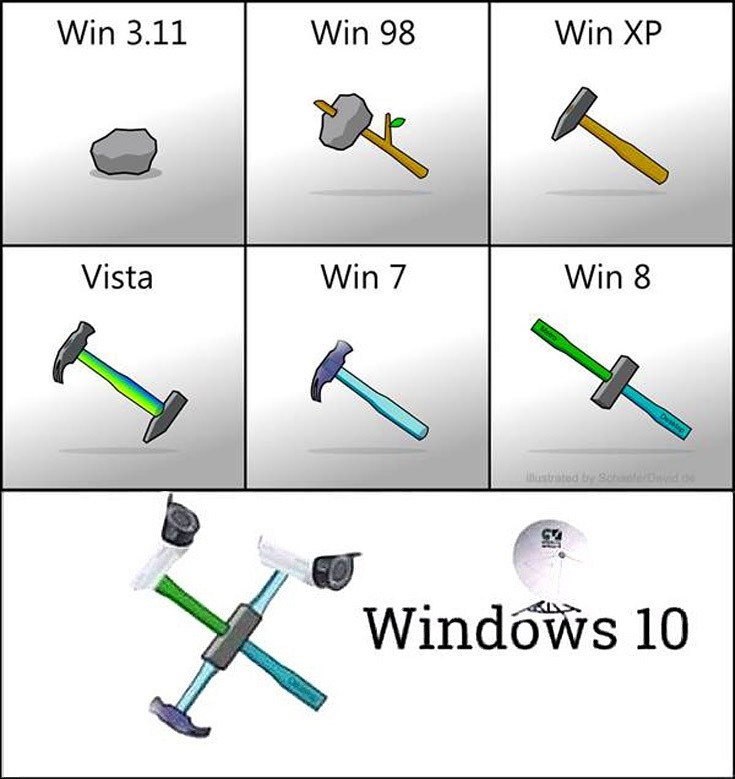
- Two kinds of font antialiasing (ClearType v2 for classic applications and some awful dirty grayish something for Modern apps). Truth to be told it's not a problem with HiDPI monitors but few people own them.
- All kinds of varying visual decorations and styles (some people have discovered up to seven varying styles in Windows 10).
- Absolutely dissimilar classic and modern (PC settings) control panels.
- Different font faces and sizes all around.
- Different styles of settings for modern apps.
- Absolutely different context menus and their appearance in different applications and apps.
- Terrible hardly-configurable appearance, dubious design choices and extremely limited functionality (vs Windows 7/XP):
- Two Control Panels with absolutely zero thought given to how they differ and why each one should be used.
- Some Control Widgets are spread between the two Control Panels which is utterly confusing (e.g. User Management).
- No Windows classic UI for windows decorations. Windows decorations can hardly be configured at all in Windows 10.
- An awful choice of colors/palette.
- Absolutely awful, childish and amateurish icons (the current release features slightly better icons) as if we live in the era of eight-bit displays (only rivalled by those in Windows 3.1 from 1992). Windows 2000 in 1999 looked better than Windows 10 in 2015.
- A big number of Windows 10 apps are still NOT on par with their classical counterparts from Windows 7/Vista/XP (many features are missing or many options are not configurable).
- The start menu is an unusable abomination. Sometimes classic Win32 applications are not listed anywhere. Applications are listed as a list which is nigh impossible to scroll.
- Windows 10 sucks terribly if you are an unlucky user of a metered Internet connection:
- It features huge mandatory system and apps updates (you cannot disable them, you can only postpone the system reboot after their installation). A note for smug commentators: certain home users/companies use a 3G uplink connection (for instance via a router which supports USB 3G modems), which means Windows 10 doesn't and cannot know how it's connected to the Internet.
- By default it uses your free bandwidth to distribute updates to other users nearby you.
- As if it wasn't enough, Windows 10 gets downloaded automatically if you run Windows 7 or 8.1. We are talking about 3-6 gigabytes of data some people absolutely do not need.
- Windows 10 Pro edition has become more or less unsuitable for small enterprises because Windows 10 anniversary update removes the ability to disable the following "features" (more like annoyances):
- Microsoft Consumer Experience: personalized recommendations or, in simple terms, ads in the start menu.
- Windows Tips.
- The Lock Screen.
- Disable all apps from the Windows Store.
- Interesting (read awful) features for developers and power users:
- Visual Studio 2015 C++ compiler secretly inserts telemetry code into binaries.
- Windows 10 anniversary update blocks all drivers which are not signed by Microsoft. At the moment the ext2fsd driver and VirtualBox will cease to function.
- In Windows 10 certain not-so-old games and applications either do not work or have severe problems (old StarForce drivers are not supported).
- A new shocker: Windows 10 installs apps behind your back without your approval. The first Windows anniversary update without asking first reinstalls Skype and auto-logins you.
- Windows 10 resets your default applications to built-in Microsoft's ones after each major update.
- As has already been mentioned, different Windows 10 releases are different operating systems altogether, so Microsoft is "free" to deprecate the support for your hardware even if it came with Windows 10 preinstalled. So, Microsoft decided it no longer wants to allow new Windows releases on PCs having an Intel Clover Trail Atom CPU inside.
- A newly-created user profile weighs over 300MB (!) while containing zero (!) information about the user.
- A newly-created user profile is populated with all the default apps instead of giving the user a choice.
- Windows 10 shows full-screen ads on your lock screen.
- With Wi-Fi sense enabled anyone you have in your Skype, Outlook or Hotmail contacts lists — and any of your Facebook friends - can be granted automatic access to your Wi-Fi network as long as they're within range.
- March 2017 update: Windows Explorer now shows ads for OneDrive.
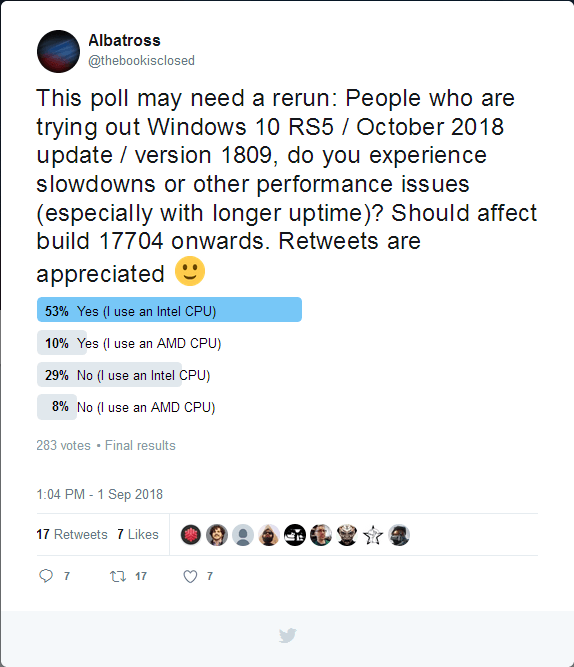


Some ways to fix/configure Windows 10
- Do not install it or upgrade to it if you're running Windows 7/8.1. If you did, read further.
- Install Open Shell (a fork of Classic Shell) aka Windows 7 (XP) Start Menu for Windows 10.
- Uninstall/remove most built-in Metro/Modern apps in Windows 10 (quiet a lot of them are immutable and cannot be uninstalled no matter what):
- Fire up an administrator's PowerShell (Start -> Search -> Power -> Right mouse click -> Run as Administrator).
- Run (copy and paste):
Get-AppXPackage -User | Remove-AppxPackage (remove the user's apps)
Get-AppXPackage -AllUsers | Remove-AppxPackage (remove all system-wide apps)
- Disable Windows 10 most spying/tracking/call home features - for deep cleaning use more powerful (and equally dangerous) utilities.
- You can disable the built-in torrent-like/bandwidth sharing feature by going to the Start Start button icon
 , then Settings > Update & security > Windows Update, and then select Advanced options.
 - The other things mentioned above cannot be fixed unfortunately (UI inconsistency, two Control Panels, very little UI customizability, disabling of updates, etc.).
Why was Windows 10 spyware? (stopped being so after July 29, 2016)
Because it has all the attributes of spyware:- Downloads itself to your machine without you specifically asking for it? YES
- Aggressively attempts to install itself taking over your computer in the process? YES
- Sends unknown and/or encrypted data to known and unknown third parties? YES
- Sends personally identifying information to known and unknown third parties? YES
- Difficult to remove? YES
As a bonus, Windows 10 has the features of a PUP: it shows ads in the start menu including full-screen ads on the lock screen.
Busting Windows 10 myths
There seems to be a good number of myths which are spread on pro-Microsoft forums and websites and I want to take a bit of your time to debunk them.Windows 10 is faster
According to this, this and this there's no discernible difference between Windows 7, 8.1 and 10. Windows 10 features improved memory handling for certain multithreaded applications like WinRAR, but most other applications have the same performance.
"I have installed Windows 10 and it feels faster", right, like with every Windows release it feels fast when you install it from scratch. Then, strangely, it slows down significantly.
I have nothing to hide - let them track me!
Robin Doherty has a nice piece on this issue: "Why privacy is important, and having 'nothing to hide' is irrelevant". Also you might want to read about the implications of real-life surveillance.
Here's an insightful comment I cannot agree more with:
"Microsoft has given themselves the right to do remote administration and data gathering ... and for all but the ones which can select Security, they'll do it in such a way that they can personally identify you. Oh, and apparently they'll gather some of your documents as well. No fucking way we can trust them with this, because as soon as they have the ability to tell your computer to package up some data and send it to them, some asshole in law enforcement is going to demand they misuse it. And don't say they won't, because that's exactly the kind of shit law enforcement and the security agencies are doing. No way they won't show up with an NSL demanding information and forbidding Microsoft from admitting to it."
I've got Windows 10 preinstalled on my PC/laptop, I hate it, what should I do?
If you do value your freedom, privacy and ability to control your OS, not the other way around, you've get these options:
- Downgrade to Windows 8.1 or even better to Windows 7 (can't
recommend 7 any longer as it will stop being supported starting January,
2019) which contains zero privacy invasion features. Make sure
you have automatic updates set to "Check for updates but let me choose
whether to download and install them". Review and research every non-security update before installing it. Also you might want to disable telemetry bits and upgrade elements in Windows 7/8.1 - use with caution.
Mind that Microsoft stopped offering Windows 7/8.1 updates to the owners of new PCs with new Intel/AMD CPUs.
Also mind that finding drivers for older Windows releases has become extremely difficult for new hardware (released after 2015). - If everything you do on your PC is web browsing, watching online videos and listening to online music, give Linux a try. You don't even have to install it to try it - it can be trivially run from your USB flash drive without touching your OS or personal data. Linux is slowly becoming a nice alternative to Windows.
- Migrate to MacOS. This is the most expensive option but the most viable at the moment because Linux is not exactly perfect.
Free upgrade to Windows 10 (updated)
How to save money and upgrade to Windows 10 for free after the free upgrade offer expires? + U
and enable the onscreen keyboard and follow this linkOfficially in January 2018 Microsoft ended this offer. But not really - read on.
Update: it turns out the offer is still valid and you can upgrade to Widnows 10 for free if you own a copy of Windows 7 or 8. I've just saved you up to $199.
In conclusion
Just before you call me anti-Microsoft, a Linux shill, zealot or fanatic, here's a wonderful list of Linux problems that I've been compiling over the past six years. The truth is I don't plead allegiance to any OS on the market. So, sorry, Windows 10 sucks no less than Linux sucks, it just sucks differently. So far, Microsoft has had two great modern OSes: Windows XP and Windows 7 (in the past they had rock-solid Windows NT 4.0 and Windows 2000).I have no opinion on MacOS X, because I've never had a chance to use it, however from what I've seen on screenshots, this OS has the worst font antialiasing among any existing OSes - I actually refuse to try it because I don't want to hurt my eyes (not an issue for Macs with "retina" displays but they are even more expensive).
I'm not a journalist and I've never been one.
P.S. If you want to reinforce your love towards Microsoft and Windows 10 go to neowin.net - this website has thousands of raving idiots who dribble and moan with excitement over everything made by Microsoft.
Some guy from game-debate dot com rewrote this article in an easy-to-understand way.
Leave your comments, additions and hatred below.
Subscribe to:
Posts
(
Atom
)