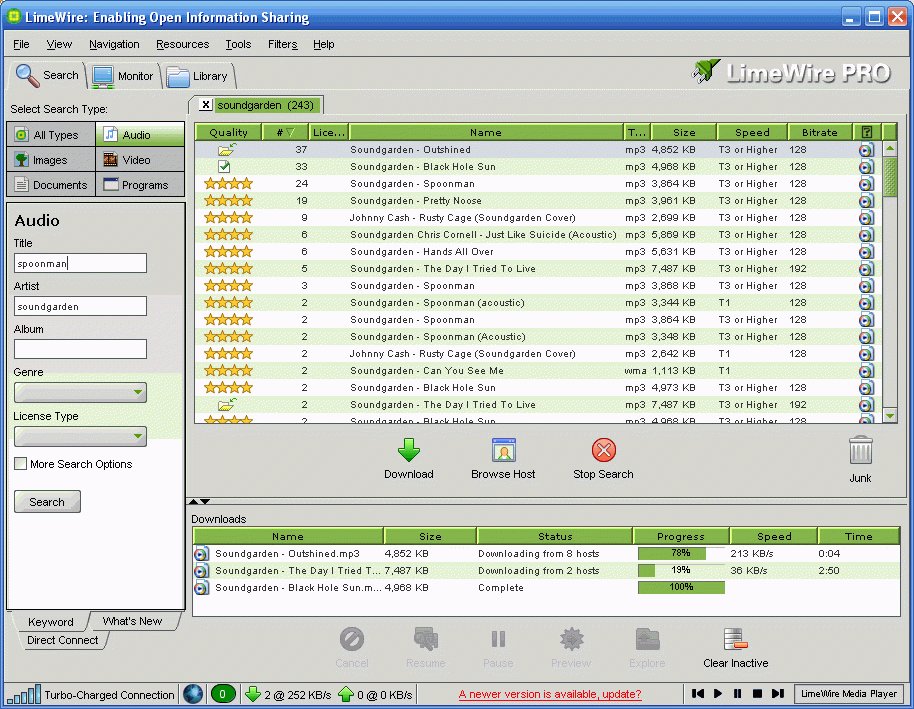
Reports of the MP3's death have been greatly
exaggerated. Earlier this month, one of the patent holders for the audio
file type, the German technology institute Fraunhofer,
announced that in April it had allowed its patents to expire.
Fraunhofer releasing its patents doesn’t mean MP3s will
cease to exist, though — it simply means the ubiquitous file type has
been released into the wild, making it easier for developers
who had previously been unable to support the file type to now go forth
and use the file extension any way they want.
Was the tolling of the death knell premature? Though the
MP3 file might have been eclipsed among audiophiles by other file
compression technology that arguably delivers better sound quality, it
has yet to be replaced in the public eye; after all, we still refer to
audio devices as “MP3 players,” not, for example, “AAC players.”
Then again, with so much music consumption happening
through streaming media and phone apps, MP3 players themselves seem like
analog technology — and major music technology players like Apple
jettisoned the MP3 years ago for greener pastures in the form of these
“better” file types.
So which is it — are MP3s DOA, or finally free?
The answer is kind of complicated. Sure, the MP3 isn’t
what it used to be — an inescapable, ubiquitous part of the digital
musical landscape — but it’s also not going anywhere.
Be free, MP3, be free
The expiration of Fraunhofer’s patents means that as of April, the MP3 is no longer tethered to
the host of encoding licenses
that hindered its development since the first patent was filed in 1987.
In practical terms, that means that anyone making a piece of audio
software can now support encoding and compression for MP3 files without
having to pay a licensing fee.
This open access to the file type is a
good thing, both for developers who need to make their software support
the greatest range of file formats possible, and for laypeople who may
be familiar with “.mp3” as a file extension but not much else.
For most of us, the news might not change much, because
MP3s come pre-licensed on most of our phones and computers. But for app
developers, open source software nerds, and especially Linux users, the
news is significant. For example, before the Fraunhofer announcement,
several pieces of software that run on Linux, like Fedora,
Tumbleweed, and
Vivaldi,
had to use third-party hacks in order to work around MP3 licensing
requirements. After the licenses expired, developers began to
immediately
enable support.
So why has there been so much haste to declare the format dead?
For starters, the Fraunhofer Institute owns patents on
another file format that is generally considered to be better — the AAC file, or
Advanced Audio Codec. YouTube has
plenty of
videos
attempting to audibly illustrate the difference between the sound
quality of an MP3 file and an AAC, but the gist is that AAC files are
generally thought to sound better at lower compression rates, or
bitrates. Compared with a standard MP3 file, an AAC file sounds sharper
and takes up less space on your computer.
This quality difference is partly why Bernhard Grill, director of Fraunhofer’s audio encoding initiatives,
told NPR that the AAC file should be considered “the de facto standard for music download and videos on mobile phones.”
However, there’s a huge catch: Fraunhofer also controls the licensing for the AAC file format, and makes money off
the licensing fees. So of
course Fraunhofer’s director wants it to be considered the “de facto standard” file format we should be using.
In actuality, there are already several other file formats, notably
FLAC,
Ogg Vorbis, and
Opus,
that don’t come with the same licensing restrictions but do offer the
same amount of quality as an AAC. So if developers were prioritizing
musical quality, optimized storage space,
and accessibility for all, the new “de facto standard” could easily be one of these other free, open source file formats.
But there are also plenty of other reasons why it’s a bit
silly to declare the MP3 in its current state to be dead, and they all
boil down to two facts: The MP3 is everywhere — and as digital audio
formats go, it’s still pretty great.
Like other classic file formats before them, MP3s are here to stay
Marco Arment, developer of the
Overcast podcast app, mounts a nice defense of the MP3
in a blog post about
the inaccuracy of the media’s spin on the file. He notes that in terms
of sound quality and file size, the difference between a
standard-bitrate AAC and a standard-bitrate MP3 is
pretty negligible for the average listener
— though it’s arguable that what kind of music you’re listening to
matters here as well. For most people, however, if you’re not doing a
lot of deep sound editing and aren’t a hardcore audiophile, an MP3 is
just fine.
This is especially relevant for the
culture of podcasting, where the DIY nature of recording and uploading
means most podcasts will gravitate toward the universal audio standard
we all still use. Arment reports that, statistically, MP3 is the file
extension of choice for podcasters, pointing out that “among the 50
million podcast episodes in Overcast’s database, 92 percent are MP3, and
within the most popular 500 podcasts, 99 percent are MP3.”
Arment also compares the MP3 to another classic file extension that’s shaped the way we think about the internet — the JPEG:
MP3 is very old, but it’s the same age as
JPEG, which has also long since been surpassed in quality by
newer formats. JPEG is still ubiquitous ... because it’s good enough and supported everywhere, making it the most
pragmatic choice most of the time.
In other words, most of us are going to keep using the
MP3 for the same reason we still save images as JPEGs: The quality is
fine for our purposes, it’s supported on all the software we use, and
we’re used to it. Why wouldn’t we keep using it?
Expanding this comparison, one tech writer, Mac Observer’s Jeff Gamet,
specifically compared
the de-licensing of the MP3 to the GIF, which completely exploded
across the internet and transformed internet culture as we know it — all
after its patents expired in 2003. It’s hard to see how a file format as ubiquitous as the MP3 could become even
more
integral to the internet, but the beauty of unrestricted, open access
to data is that you never know where that access is going to lead.
So don’t lower the flags for the MP3 just yet, or hold a funeral for your
Zune.
On the internet, things live and die not by license expiration dates,
but by the public’s willingness to keep uploading and downloading them.
And by that standard, the MP3 is almost certainly here to stay.