My high school Linux distribution at Chippewa Valley Technical College saved on Archive.org I remember writing a Red Hat 7.2 review in 2002.
I also find images of an old Suse Linux 9.2 from 2004. There is also Suse Linux 9.3.
They keep these ancient distributions online so Hollywood can film "The Social Network".
Full directory
Friday, December 20, 2013

Saturday, December 14, 2013
Match box and Hotwheels
I have quite the story to tell you about Matchbox and Hot Wheels. I've read at least 20 articles from the US and UK how children and adults alike should collect these toy cars. Now, I hate to be the adult in the room, but I sold my collection to goodwill! I had about 60 cars in a briefcase. Matchbox and Hot wheels predated my first videogame console. I had LEGOs (that I still own), Matchbox, Hot Wheels when I was 10, but that was then.
I made a lot of bad decisions in my childhood such as I didn't collect Warhammer 40,000, Magic the Gathering and Dungeons and Dragons when I was 10. These reasons only result in unpopularity. I was in the doomed to fail childhood of the 1990s predating all Facebook, ICQ, MIRC, MSN Messenger and EXTREME limited access to dial up Internet.
I was absolutely right about stop collecting LEGOs however. Mall of America LEGO center had children playing there and everybody around here has gone to Mall of America at least twice in their lifetime.

I made a lot of bad decisions in my childhood such as I didn't collect Warhammer 40,000, Magic the Gathering and Dungeons and Dragons when I was 10. These reasons only result in unpopularity. I was in the doomed to fail childhood of the 1990s predating all Facebook, ICQ, MIRC, MSN Messenger and EXTREME limited access to dial up Internet.
I was absolutely right about stop collecting LEGOs however. Mall of America LEGO center had children playing there and everybody around here has gone to Mall of America at least twice in their lifetime.

Here is a photo of my collection.
Thursday, December 12, 2013
US Military driving US economy?
According to British experts, Russia is in the world top three in terms of military expenditure. The country is increasing its military spending, because Russian defense industry is in need of revamping and the army needs to be rearmed. However, the Russian military-industrial complex is nowhere near the absolute leadership in terms of expenditure. The first place is firmly occupied by the United States whose army is the backbone of the economy.
By the end of 2013 Russia became one of the top three leaders in terms of spending on weapons, which is not surprising. In the past year 68 billion dollars was invested in the military-industrial complex of the Russian Federation. These data were published by the Organization IHS Jane's that conducted relevant research.
Russia has no intention to cut its military spending. On the contrary, even a more significant amount - $78 billion dollars will be invested in the Russian military-industrial complex in 2014, and each subsequent year the defense spending will increase by $10 billion.
However, Russian experts believe that Russia's accession to the top of this ranking (especially given that it comes from a British study) does not mean that Russia will be able to quickly move the undisputed leaders of the defense - the U.S. and China, which is not surprising given the political system of China and the U.S. aggressive philosophy.
"Russian cannot become a leader in military spending in the coming years, even decades. Why? It is sufficient to compare our spending and that of the Americans," Boris Yulin, a historian and military expert shared with Pravda.Ru. "The fact that Russia is on the third place does not mean that we are only a little behind. We are lagging behind significantly. The entire U.S. economy rests exclusively on military power. That is, the dollar is backed by the American aircraft carriers, nuclear submarines and aircraft, American military bases around the world, and not the American economy."
The expert stressed a very important point - the Russian army is equipped with very outdated weapons. In fact, Russia's defense industry requires enormous funds, not because the defense industry requires development, but because, in principle, the Russian army needs to be rearmed. According to Boris Yulin, there is a need to eliminate one big gap that occurred in the defense industry in the 1990s and early 2000s, the period when there was no military construction, production was halted, and the survivors managed to stay afloat only because of foreign orders.
"Today we have to make a breakthrough, because we have been disarming for a quarter of a century," told Pravda.Ru Colonel-General, historian and president of the Academy of Geopolitical Issues Leonid Ivashov. "We declared that we had no external enemies, that we served as an example of a peaceful nation, and robbed and disarmed the entire defense sector and budget, privatized defense industry, and destroyed the armed forces.
According to the officer, the increased investment in the Russian military-industrial complex is due to global military and political events of recent years that clearly showed the West's position in relation to the countries rich in natural resources.
"It is extremely difficult to rebuild what was being destroyed for a quarter of a century, despite the fact that the defense is constructed as a system. Today, some elements of the system are preserved through the activity of the designers and directors. Something was preserved by foreign orders, trading on the global arms market'; something was preserved in Ukraine, Belarus, and so on. Now the task is to combine it all and give it a new spin, a new modern quality to the weapons required by the army. Today we may not be the third," suggested Leonid Ivashov, adding that Russia will never be the leader. "Because from time immemorial we have had a defensive rather than aggressive policy, and the defense is less expensive than the offense."
It appears that Russia does not have a goal to be a global leader in terms of defense expenditure. That is, of course, the military might needs to be enhanced, and advanced weapons, missile defense system, and so on need to be developed. High military spending is an indicator of a country's foreign policy.
The U.S. is building its dominant role in world affairs through active hostilities. China is climbing towards global leadership by conducting a military reform. Russia's development of military industry has other reasons. Russia cannot ignore major combat operations conducted in the last decades on the Eurasian continent when most of its land is occupied by Russia. Today it is extremely important for Russia to develop air defense systems, space defense and other branches of the armed forces, which would provide reliable protection of the Russian borders and continue to give weight to Russia's decisions regarding world events. Let major military spending remain the privilege of the countries whose economies would immediately collapse without these injections.
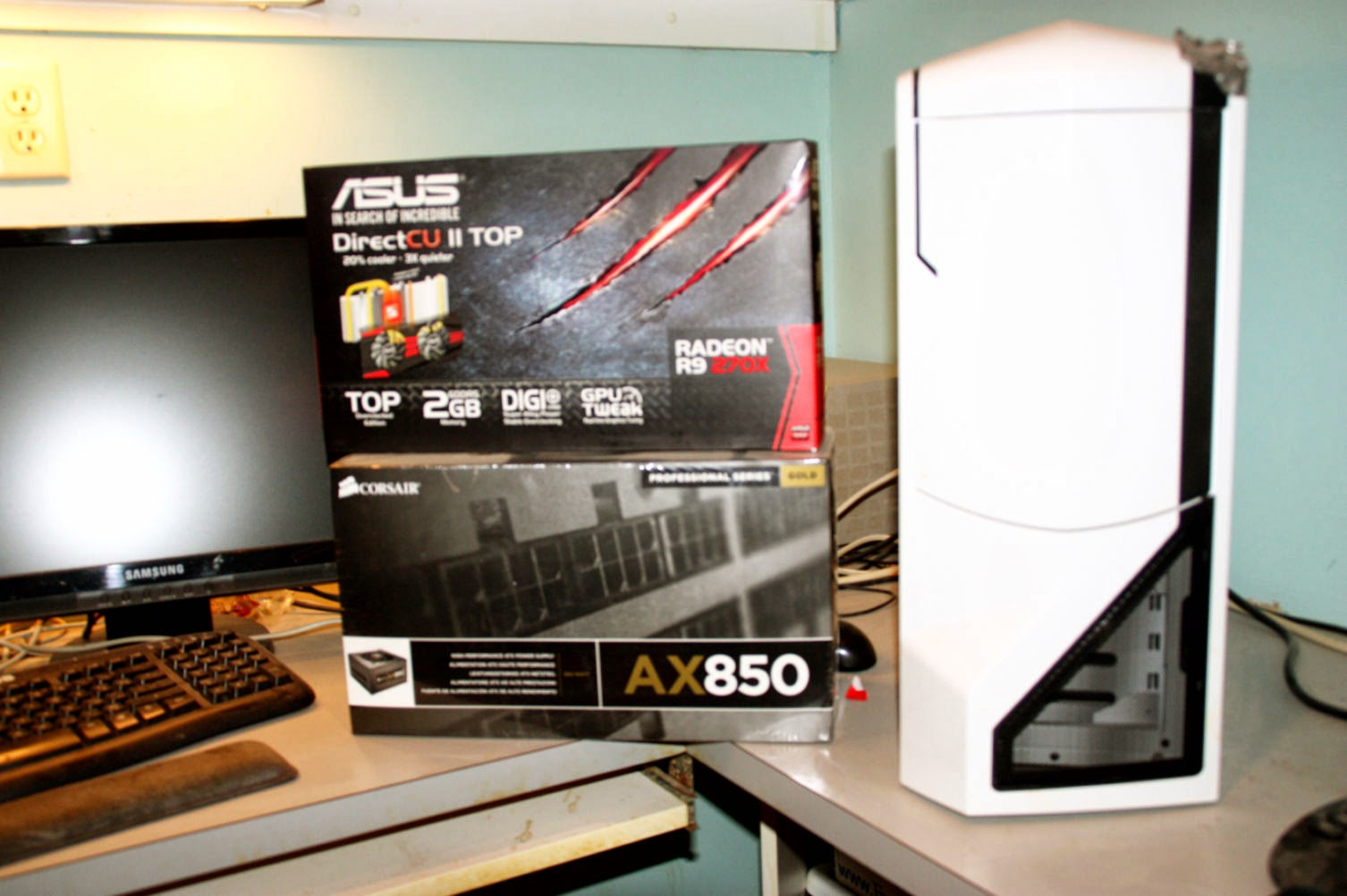
Bought a ASUS Radeon R9 270
I bought myself an early Christmas present, the ASUS Radeon R9 270 2 GB graphics processing unit for $200. I can play PC games on my other PC. My other PC has a Radeon HD 5970 Black Edition.


The Xbox One has a faulty Bluray drive at launch. The Xbox 360 wasn't reliable until the Falcon CPU chip from 2009. New Xbox 360 prices are unbelievable, past $300. New Playstation 3s cost half that.
The Xbox One has a faulty Bluray drive at launch. The Xbox 360 wasn't reliable until the Falcon CPU chip from 2009. New Xbox 360 prices are unbelievable, past $300. New Playstation 3s cost half that.
Monday, December 09, 2013
The Malazan Book of the Fallen by Steven Erikson

I’m going to state it right out – The Malazan Book of the Fallen by Steven Erikson
is the most ambitious epic fantasy series ever written – this is both
its greatest strength and greatest weakness. Rather than ambition, fans
of epic fantasy are much more likely to honor tradition and nostalgia,
but the genre has come far from where it was effectively defined by The Lord of the Rings and fans have grown as well. These days gritty and subversion seem to be the buzz words of fantasy fans, and while The Malazan Book of the Fallen certainly meets both in numerous ways, it really is much more.

It’s been ambitious since the start when Erikson proposed Malazan
to be a 10-book series back in the 1990s – there was never any
trilogy-creep, this was always going this long. But of course it isn’t
so simple – the series is not Erikson’s alone. The Malazan
world was co-created with Ian C. Esslemont who has written three books
of his own that support the series, with three more to come. While
Erikson’s 10-book series is complete, once Esslemont finishes his parts
it will be more complete, perhaps making this review a bit premature.

The Malazan
world has its origins in Dungeon’s and Dragons and GURPS role-playing
campaigns played out by Erikson and Esslemont and has since grown in
ambition. In many ways the series is meant to be more of a response to
epic fantasy than a part of it. Not in the same ‘FU’ manor as The First Law by Joe Abercrombie,
but again as something more. Ultimately, it’s about the human condition
and the cost of civilization, but again it’s more. The series is also
about deception in something of a post-modern, meta-fictional way. While
the foreshadowing is present, and even a rubric to the whole series
buried in one of its volumes, it’s still difficult to see beneath
surface. It’s all light, darkness and shadow with more than a bit of
sleight of hand.

However,
don’t let me mislead you into thinking that it’s not epic fantasy,
because it is. Like most epic fantasy, this is a book of war and magic.
And the magic plays an incredibly important role – it’s
powerful…all-powerful. The scope and horror of magic is laid out from
the beginning, while the mechanics of it remain an enigma. In every book
we meet a hidden power that rises to tremendous, spectacular heights.
Of course that’s the point of it – readers may want to call foul, may
want to shout dues ex machina, but they miss the point.

The series begins as a tale of a conquering Malazan Empire that has overextended itself. In Gardens of the Moon (Book Depository, Powell’s Books, Indiebound)
the reader is dumped strait into the middle of it all without the
typical build-up. This can be exhilarating, overwhelming, and
off-putting, though I found it immensely rewarding. We get a feel for a
mix of races and species that is huge and a rich world history with gods
and other powerful immortals that literally walk the land, interfering
with mortal lives. Though some mortals interfere right back, for gods
can die too. It’s through this complex tapestry that Erikson focuses on
humanity. Every soldier is a philosopher, every person an everyman (or
everywoman, though even with numerous female characters, the series has
an overwhelming male-ness to it), with the view of it all is just as
often through pawns as kings and queens.
‘These Malazans, they shame the gods themselves…’
 An important point the series is put right in the series title, perhaps the most important point: The Malazan Book of the Fallen.
It’s the word fallen that focuses it all. For this series is not
(necessarily) about those that live to fight another day, to see another
book, who survive the ultimate convergence of power – this series is
about the people who fall along the way. The price, the toll, the
compassion, the sacrifice, and eventually, the reward. This is a series
where the dead tend to not go away and the fallen may not die. Each book
itself shows something new, a new style, a new theme within the overall
series, but in the end there is a method to the madness of it all.
An important point the series is put right in the series title, perhaps the most important point: The Malazan Book of the Fallen.
It’s the word fallen that focuses it all. For this series is not
(necessarily) about those that live to fight another day, to see another
book, who survive the ultimate convergence of power – this series is
about the people who fall along the way. The price, the toll, the
compassion, the sacrifice, and eventually, the reward. This is a series
where the dead tend to not go away and the fallen may not die. Each book
itself shows something new, a new style, a new theme within the overall
series, but in the end there is a method to the madness of it all.I will remember this. I will set out scrolls and burn upon them the names of these Fallen. I will make of this work a holy tome, and no other shall be needed.Hear them! They are humanity unfurled, laid out for all to see – if one would dare look!There shall be a Book and it shall be written by my hand. Wheel and seek the faces of a thousand gods! None can do what I can do! Not one can give voice to this holy creation!But this is not bravado. For this, my Book of the Fallen, the only god worthy of its telling is the crippled one. The broken one. And has it not always been so?I never hid my hurts.I never disguised my dreams.And I never lost my way.
And only the fallen can rise again.
 It’s
in his ambition, this response to epic fantasy that Erikson gets in
trouble. Yes, it’s epic fantasy in the extreme – the magic and powers
overblown, the gods both more and less than they should be, the grunt
suffering through it all somehow becomes the most powerful of all. It
chafes fans of epic fantasy. It’s supposed to. Fans often decry the
seeming over-emphasis on suffering, marching, the camp-fire
conversations, the little people. While the action is incredible, it is
interspersed with long and tedious ramblings that become philosophical
and at times down-right didactic. While Erikson certainly over-indulges
himself, many fans seemingly miss the point. Or perhaps they don’t care
about the point. Many will fail to complete the journey of the series,
many will be upset, disappointed, even angry with Erikson for what he
writes. The criticisms often wielded only show Erikson how much they
missed the point. Erikson plays with this in the text – often
proactively for areas he knows that will bring especially pointed
criticism. He knows these books aren’t for everyone, and that if
everyone likes what you are doing, you are doing it wrong. But it
clearly it stings, and sometimes Erikson seems to lash out in response.
It’s
in his ambition, this response to epic fantasy that Erikson gets in
trouble. Yes, it’s epic fantasy in the extreme – the magic and powers
overblown, the gods both more and less than they should be, the grunt
suffering through it all somehow becomes the most powerful of all. It
chafes fans of epic fantasy. It’s supposed to. Fans often decry the
seeming over-emphasis on suffering, marching, the camp-fire
conversations, the little people. While the action is incredible, it is
interspersed with long and tedious ramblings that become philosophical
and at times down-right didactic. While Erikson certainly over-indulges
himself, many fans seemingly miss the point. Or perhaps they don’t care
about the point. Many will fail to complete the journey of the series,
many will be upset, disappointed, even angry with Erikson for what he
writes. The criticisms often wielded only show Erikson how much they
missed the point. Erikson plays with this in the text – often
proactively for areas he knows that will bring especially pointed
criticism. He knows these books aren’t for everyone, and that if
everyone likes what you are doing, you are doing it wrong. But it
clearly it stings, and sometimes Erikson seems to lash out in response.‘Sad truth,’ Kruppe said – his audience of none sighing in agreement – ‘that a tendency towards verbal excess can so defeat the precision of meaning. That intent can be so well disguised in majestic plethora of nuance, of rhythm both serious and mocking, of this penchant for self-referential slyness, that the unwitting simply skip on past – imagining their time to be so precious, imagining themselves above all manner of conviction, save that of their own witty perfection. Sigh and sigh again.

Ultimately,
there is a hope to it all – this is not the nihilistic proclamation so
many claim. It’s a grand plan for the better of humanity. Only at times
the darkness, the faults and flaws, and humanity itself seemingly
deserve no hope.
‘Hedge was waiting, seated on one of the tilted standing stones. ‘Hood take us all,’ he said, eyeing Fiddler as he approached. ‘They did it – her allies – they did what she needed them to do.’
Aye. And how many people died for [it]?’…’Little late to be regretting all that now, Fid.’‘…They used all of us Hedge.’‘That’s what gods do, aye. So you don’t like it? Fine, but listen to me. Sometimes, what they want – what they need us to do – sometimes it’s all right. I mean, it’s the right thing to do. Sometimes, it makes us better people.’‘You really believe that?’‘And when we’re better people, we make better gods.’Fiddler looked away. ‘It’s hopeless, then. We can stuff a god with every virtue we got, it still won’t make us any better, will it? Because we’re not good with virtues, Hedge.’‘Most of the time, aye, we’re not. But maybe then, at our worst, we might look up, we might see that god we made out of the best in us. Not vicious, not vengeful, not arrogant or spiteful. Not selfish, not greedy. Just clear-eyed, with no time for all our rubbish. The kind of god to give us a slap in the face for being such shits.’
…’Ever the optimist, you’
 This
review both coincidently and intentionally reads like the series itself
– perhaps full of insight, perhaps full of bullshit, always seeming a
bit of mess. It’s overly long (at least compared to what I tend to
write), it’s defensive, dismissive, disagreeable and likely to piss a
few people off. The review is journey, a misinterpretation, and it gets
it right. And it’s ever self-aware, perhaps to a fault. It’s the most
ambitious review I’ve ever written.
This
review both coincidently and intentionally reads like the series itself
– perhaps full of insight, perhaps full of bullshit, always seeming a
bit of mess. It’s overly long (at least compared to what I tend to
write), it’s defensive, dismissive, disagreeable and likely to piss a
few people off. The review is journey, a misinterpretation, and it gets
it right. And it’s ever self-aware, perhaps to a fault. It’s the most
ambitious review I’ve ever written.
The Malazan Book of the Fallen
isn’t for everyone, and in many ways it may not be for fans of epic
fantasy. While it is absolutely for the fans. And it’s the most
ambitious epic fantasy out there – period. Though the Malazan
series by Erikson is over, something of an epilogue remains to be
written by Esslemont and Erikson has promised two more trilogies and a
continuation of the novellas set in the world. The dead don’t stay dead.
The fallen may not be who you think they are and can rise again.
Perfect.
And now the page before us blurs.
An age is done. The book must close.
We are abandoned to history.
Raise high one more time the tattered standard
Of the Fallen. See through the drifting smoke
To the dark stains upon the fabric.
This is the blood of our lives, this is the
Payment of our deeds, all soon to be
Forgotten.
We were never what people could be.
We were only what we were.
Remember us
Subscribe to:
Posts
(
Atom
)