One more element may soon be
added to the Periodic Table. On September 10, 2013, an international
team of scientists working at the GSI Helmholtz Center for Heavy Ion
Research in Darmstadt, Germany reported that they have acquired new
evidence supporting the existence of element 115. The new evidence will
be reviewed by the International Union of Pure and Applied Chemists
(IUPAC), and if confirmed, element 115 will likely be given a new name
and added to the Periodic Table of Elements. Its temporary name, which
is being used as a placeholder, is ununpentium.
Element 115 is one of a number of
superheavy elements—elements with an atomic number greater than 104—that
are so short-lived, they can’t be detected in nature. Scientists can,
however, synthesize these elements in a laboratory by smashing atoms
together.
In 2004, scientists from the United States
and Russia first reported the discovery of element 115. Unfortunately,
the evidence from that research and a few more studies that followed was
not enough to confirm the existence of a new element.
Now, scientists are developing new
techniques to detect the presence of superheavy elements. In an
experiment conducted at the GSI Helmholtz Center for Heavy Ion Research
in Darmstadt, Germany, scientists successfully bombarded a thin layer of
americium (atomic number 95) with calcium (atomic number 20) to produce
ununpentium (atomic number 115). Ununpentium was observed with a new
type of detector system that measured the photons that were released
from the reaction. The unique photon energy profile for ununpentium can
be thought of as the element’s fingerprint, the scientists say.
Dirk Rudolph, lead author of the new study
and Professor at the Division of Nuclear Physics at Lund University in
Sweden, commented on the findings in a
press release. He said:
This can be regarded as one of the most important
experiments in the field in recent years, because at last it is clear
that even the heaviest elements’ fingerprints can be taken. The result
gives high confidence to previous reports. It also lays the basis for
future measurements of this kind.
Presently, there are 114 elements in the Periodic Table of Elements.
Two new elements,
flerovium (atomic number 114) and livermorium (atomic number 116), were
added to the Periodic Table in 2012. While elements 113 and 118 are
also thought to exist, their presence has not yet been confirmed.
The next step for element 115 will be for
the IUPAC to review all of the evidence to date and make a decision as
to whether more experiments are needed or if the current evidence is
sufficient to support the discovery of a new element. If the latter
occurs, the scientists who first discovered element 115 will be asked to
formally submit a new name for the element. Then, the new name will be
released for scientific review and public comment. If approved, the
element along with its new name will be added to the Periodic Table of
Elements. Element 115 is currently called ununpentium, which is just a
placeholder until its formal name is established.

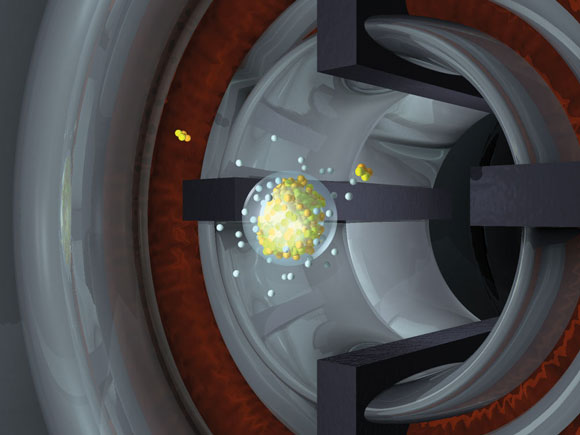
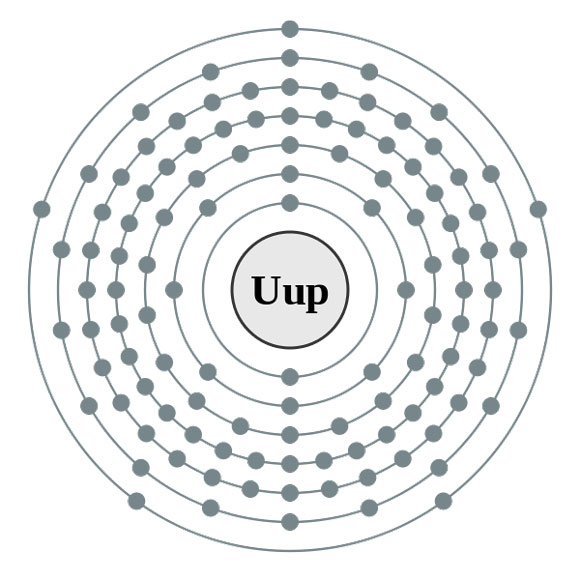
Nucleus of ununpentium (Uup) surrounded by a cloud of electrons. Image Credit: Wikimedia Commons.
The research was supported by ENSAR
(European Nuclear Science and Applications Research), the Royal
Physiographic Society in Lund, the Swedish Research Council, the German
Federal Ministry of Education and Research, the US Department of Energy
and the UK Science and Technology Facilities Council.
Bottom line: On September 10, 2013, an
international team of scientists working at the GSI Helmholtz Center for
Heavy Ion Research in Darmstadt, Germany reported that they have
acquired new evidence that supports the existence of element 115
(ununpentium). The research was published on September 10, 2013 in the
journal Physical Review Letters. After the IUPAC reviews and confirms
the evidence, element 115 will likely be given a new name and added to
the Periodic Table of Elements.
All of this would excite only
physics and
chemistry geeks if not for
Bob Lazar (1959- ), who introduced it to
UFO lore. According to him,
UFO engines use element 115 to generate
anti-gravity. Various UFO nuts and
wannabe scientists have taken the idea and run with it.
[3]
This would provide an interesting way of verifying the UFO stories told
by Lazar. Should element 115 be synthesised and shown to be capable of
powering anti-gravity engines, Lazar's claim would have some serious
support. Obviously, given that Lazar runs a website dealing in chemicals
and sales of elements, he was smart enough to pick a number higher than
any element discovered at the height of his fame in order to hide it
from any scrutiny; no use saying
carbon or phosphorus has magical powers, as we have more than enough of that to test it.
Lazar's claims state that bismuth has "unusual gravitational
properties" (this is flatly false, though it may be a misinterpretation
of the
relativistic effects
that control the chemical properties of heavier elements) and known
characteristics of Element 115 are expected to be similar (not that this
matters, as the longest reported half-life of the element is 200
milliseconds). The claims further state that the element was pressed
into discs, then stacked and fused into a cylinder, then milled down to
form a cone, and finally sliced to form the key piece of anti-gravity
fuel. Again, this is physically impossible given that the element
doesn't exist in nature and has been confirmed to be as highly unstable
as all the other artificially-generated elements in that region of the
periodic table. A few proponents of the claim still rave that there may
be a magic "island of stability" (a particular combination of protons
and neutrons) that would render this element stable, but no signs of
such a region of the periodic table have emerged. Some of the elements
heavier than uranium possess relatively stable isotopes (on the order of
thousands of years) but by the time you get to 100, fermium, even the
most stable isotopes last on the order of days and it only goes rapidly
down from there. Still, the island of stability is a theoretical entity
that is good, real physics — but even this wouldn't help the claims made
about element 115, as expected half-lives in this island are on the
order of minutes and seconds, which is indeed
relatively stable in a region of the periodic table where the atoms last for milliseconds or less.
If one could synthesise element 115 (specifically its predicted
stable isotope) more conclusively and show it to have an incredibly
short half-life and radioactive unstability (which is pretty much
conclusive right now), it would show that powering
any device
through the use of this element would be impossible, and certainly the
500 pounds that he claimed the US government had in their possession
would also be an
impossible claim. Literally. As that would consist of around 4.72 × 10
23
atoms, and with only 50 atoms ever made from all the collision
experiments made on this subject in a decade, this would take some time
for the government to procure — many times the age of the
Universe, or so.