want to tell you straight off what this story is about: Sometime in the next 40 years, robots are going to take your job.
I don’t care what your job is. If you dig ditches, a robot will dig
them better. If you’re a magazine writer, a robot will write your
articles better. If you’re a doctor, IBM’s Watson will no longer “assist”
you in finding the right diagnosis from its database of millions of
case studies and journal articles. It will just be a better doctor than
you.
And CEOs? Sorry. Robots will run companies better than you do.
Artistic types? Robots will paint and write and sculpt better than you.
Think you have social skills that no robot can match? Yes, they can.
Within 20 years, maybe half of you will be out of jobs. A couple of
decades after that, most of the rest of you will be out of jobs.
In one sense, this all sounds great. Let the robots have the damn
jobs! No more dragging yourself out of bed at 6 a.m. or spending long
days on your feet. We’ll be free to read or write poetry or play video
games or whatever we want to do. And a century from now, this is most
likely how things will turn out. Humanity will enter a golden age.
But what about 20 years from now? Or 30? We won’t all be out
of jobs by then, but a lot of us will—and it will be no golden age.
Until we figure out how to fairly distribute the fruits of robot labor,
it will be an era of mass joblessness and mass poverty. Working-class
job losses played a big role in the 2016 election, and if we don’t want a
long succession of demagogues blustering their way into office because
machines are taking away people’s livelihoods, this needs to change, and
fast. Along with global warming, the transition to a workless future is
the biggest challenge by far that progressive politics—not to mention
all of humanity—faces. And yet it’s barely on our radar. We Already Have a Solution for the Robot Apocalypse. It’s 200 Years Old.
That’s kind of a buzzkill, isn’t it? Luckily, it’s traditional that
stories about difficult or technical subjects open with an entertaining
or provocative anecdote. The idea is that this allows readers to ease
slowly into daunting material. So here’s one for you: Last year at
Christmas, I was over at my mother’s house and mentioned that I had
recently read an article about Google Translate. It turns out that a few weeks previously, without telling anyone, Google had switched over to a new machine-learning algorithm.
Almost overnight, the quality of its translations skyrocketed. I had
noticed some improvement myself but had chalked it up to the usual
incremental progress these kinds of things go through. I hadn’t realized
it was due to a quantum leap in software.
But if Google’s translation algorithm was better, did that mean its
voice recognition was better too? And its ability to answer queries?
Hmm. How could we test that? We decided to open presents instead of
cogitating over this.
But after that was over, the subject of erasers somehow came up.
Which ones are best? Clear? Black? Traditional pink? Come to think of
it, why are erasers traditionally pink? “I’ll ask Google!” I told everyone. So I pulled out my phone and said, “Why are erasers pink?” Half a second later, Google told me. Roberto Parada
Not impressed? You should be. We all know that phones can recognize
voices tolerably well these days. And we know they can find the nearest
café or the trendiest recipe for coq au vin. But what about something
entirely random? And not a simple who, where, or when question. This was
a why question, and it wasn’t about why the singer Pink uses
erasers or why erasers are jinxed. Google has to be smart enough to
figure out in context that I said pink and that I’m asking
about the historical reason for the color of erasers, not their health
or the way they’re shaped. And it did. In less than a second. With
nothing more than a cheap little microprocessor and a slow link to the
internet.
(In case you’re curious, Google got the answer from Design*Sponge:
“The eraser was originally produced by the Eberhard Faber Company…The
erasers featured pumice, a volcanic ash from Italy that gave them their
abrasive quality, along with their distinctive color and smell.”) Still not impressed? When Watson famously won a round of Jeopardy! against the two best human players of all time, it needed a computer the size of a bedroom to answer questions like this. That was only seven years ago. What do pink erasers have to do
with the fact that we’re all going to be out of a job in a few decades?
Consider: Last October, an Uber trucking subsidiary named Otto delivered 2,000 cases of Budweiser
120 miles from Fort Collins, Colorado, to Colorado Springs—without a
driver at the wheel. Within a few years, this technology will go from
prototype to full production, and that means millions of truck drivers
will be out of a job.
Automated trucking doesn’t rely on newfangled machines, like the
powered looms and steam shovels that drove the Industrial Revolution of
the 19th century. Instead, like Google’s ability to recognize spoken
words and answer questions, self-driving trucks—and cars and buses and
ships—rely primarily on software that mimics human intelligence. By now
everyone’s heard the predictions that self-driving cars could lead to 5 million jobs being lost,
but few people understand that once artificial-intelligence software is
good enough to drive a car, it will be good enough to do a lot of other
things too. It won’t be millions of people out of work; it will be tens
of millions.
This is what we mean when we talk about “robots.” We’re talking about
cognitive abilities, not the fact that they’re made of metal instead of
flesh and powered by electricity instead of chicken nuggets.
In other words, the advances to focus on aren’t those in robotic
engineering—though they are happening, too—but the way we’re hurtling
toward artificial intelligence, or AI. While we’re nowhere near
human-level AI yet, the progress of the past couple of decades has been
stunning. After many years of nothing much happening, suddenly robots
can play chess better than the best grandmaster. They can play Jeopardy! better than the best humans. They can drive cars around San Francisco—and they’re getting better at it every year. They can recognize faces well enough that Welsh police recently made the first-ever arrest in the United Kingdom using facial recognition software. After years of plodding progress in voice recognition, Google announced earlier this year that it had reduced its word error rate from 8.5 percent to 4.9 percent in 10 months.
All of this is a sign that AI is improving exponentially, a product
of both better computer hardware and software. Hardware has historically
followed a growth curve called Moore’s law, in which power and
efficiency double every couple of years, and recent improvements in
software algorithms have been even more explosive. For a long time,
these advances didn’t seem very impressive: Going from the brainpower of
a bacterium to the brainpower of a nematode might technically represent
an enormous leap, but on a practical level it doesn’t get us that much
closer to true artificial intelligence. However, if you keep up the
doubling for a while, eventually one of those doubling cycles takes you
from the brainpower of a lizard (who cares?) to the brainpower of a
mouse and then a monkey (wow!). Once that happens, human-level AI is
just a short step away.
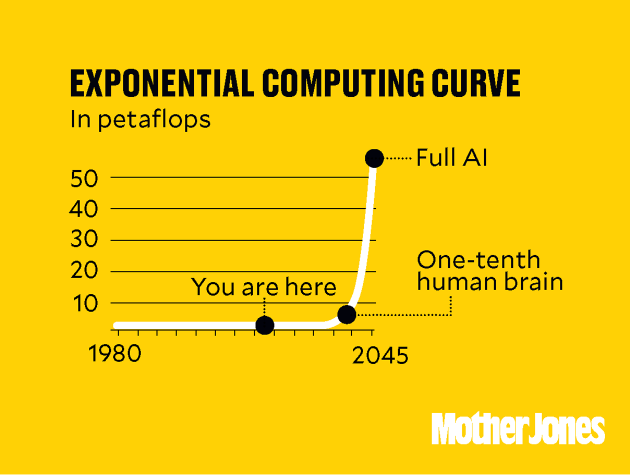
This can be hard to imagine, so here’s a chart that shows what an
exponential doubling curve looks like, measured in petaflops
(quadrillions of calculations per second). During the first 70 years of
the digital era, computing power doubled every couple of years—and that
produced steadily improving accounting software, airplane reservation
systems, weather forecasts, Spotify, and the like. But on the scale of
the human brain—usually estimated at 10 to 50 petaflops—it produced
computing power so minuscule that you can’t see any change at all.
Around 2025 we’ll finally start to see visible progress toward
artificial intelligence. A decade later we’ll be up to about one-tenth
the power of a human brain, and a decade after that we’ll have full
human-level AI. It will seem like it happened overnight, but it’s really
the result of a century of steady—but mostly imperceptible—progress.
Are we really this close to true AI? Here’s a yardstick to think
about. Even with all this doubling going on, until recently computer
scientists thought we were still years away from machines being able to
win at the ancient game of Go, usually regarded as the most complex
human game in existence. But last year, a computer beat a Korean
grandmaster considered one of the best of all time, and earlier this
year it beat the highest-ranked Go player in the world. Far from slowing
down, progress in artificial intelligence is now outstripping even the
wildest hopes of the most dedicated AI cheerleaders. Unfortunately, for
those of us worried about robots taking away our jobs, these advances
mean that mass unemployment is a lot closer than we feared—so close, in
fact, that it may be starting already. But you’d never know that from
the virtual silence about solutions in policy and political circles. I’m hardly alone in thinking we’re
on the verge of an AI Revolution. Many who work in the software
industry—people like Bill Gates and Elon Musk—have been sounding the alarm for years.
But their concerns are largely ignored by policymakers and, until
recently, often ridiculed by writers tasked with interpreting technology
or economics. So let’s take a look at some of the most common doubts of
the AI skeptics. #1:We’ll never get true AI because
computing power won’t keep doubling forever. We’re going to hit the
limits of physics before long. There are several pretty good
reasons to dismiss this claim as a roadblock. To start, hardware
designers will invent faster, more specialized chips. Google, for
example, announced last spring
that it had created a microchip called a Tensor Processing Unit, which
it claimed was up to 30 times faster and 80 times more power efficient
than an Intel processor for machine learning tasks. A huge array of
those chips are now available to researchers who use Google’s cloud
services. Other chips specialized for specific aspects of AI (image
recognition, neural networking, language processing, etc.) either exist
already or are certain to follow.
What’s more, this raw power is increasingly being harnessed in a
manner similar to the way the human brain works. Your brain is not a
single, superpowerful computing device. It’s made up of about 100
billion neurons working in parallel—i.e., all at the same time—to create
human-level intelligence and consciousness. At the lowest level,
neurons operate in parallel to create small clusters that perform
semi-independent actions like responding to a specific environmental
cue. At the next level, dozens of these clusters work together in each
of about 100 “sub-brains”—distinct organs within the brain that perform
specialized jobs such as speech, visual processing, and balance.
Finally, all these sub-brains operate in parallel, and the resulting
overall state is monitored and managed by executive functions that make
sense of the world and provide us with our feeling that we have
conscious control of our actions.
Modern computers also yoke lots of microprocessors together. As of 2017, the fastest computer in the world
uses roughly 40,000 processors with 260 cores each. That’s more than 10
million processing cores running in parallel. Each one of these cores
has less power than the Intel processor on your desktop, but the entire
machine delivers about the same power as the human brain.
This doesn’t mean AI is here already. Far from it. This “massively
parallel” architecture still presents enormous programming challenges,
but as we get better at exploiting it we’re certain to make frequent
breakthroughs in software performance. In other words, even if Moore’s
law slows down or stops, the total power of everything put together—more
use of custom microchips, more parallelism, more sophisticated
software, and even the possibility of entirely new ways of doing
computing—will almost certainly keep growing for many more years. #2:Even if computing power keeps doubling,
it has already been doubling for decades. You guys keep predicting
full-on AI, but it never happens. It’s true that during the
early years of computing there was a lot of naive optimism about how
quickly we’d be able to build intelligent machines. But those rosy
predictions died in the ’70s, as computer scientists came to realize
that even the fastest mainframes of the day produced only about a
billionth of the processing power of the human brain. It was a humbling
realization, and the entire field has been almost painfully realistic
about its progress ever since.
We’ve finally built computers with roughly the raw processing power of the human brain—although only at a cost of more than $100 million
and with an internal architecture that may or may not work well for
emulating the human mind. But in another 10 years, this level of power
will likely be available for less than $1 million, and thousands of
teams will be testing AI software on a platform that’s actually capable
of competing with humans. #3:Okay, maybe we will get full AI. But it only means that robots will act intelligent, not that they’ll really be intelligent.
This is just a tedious philosophical debating point. For the purposes
of employment, we don’t really care if a smart computer has a soul—or if
it can feel love and pain and loyalty. We only care if it can act like a
human being well enough to do anything we can do. When that day comes,
we’ll all be out of jobs even if the computers taking our places aren’t
“really” intelligent. #4:Fine. But waves of automation—steam
engines, electricity, computers—always lead to predictions of mass
unemployment. Instead they just make us more efficient. The AI
Revolution will be no different. This is a popular argument. It’s also catastrophically wrong.
The Industrial Revolution was all about mechanical power: Trains were
more powerful than horses, and mechanical looms were more efficient
than human muscle. At first, this did put people out of work:
Those loom-smashing weavers in Yorkshire—the original Luddites—really
did lose their livelihoods. This caused massive social upheaval for
decades until the entire economy adapted to the machine age. When that
finally happened, there were as many jobs tending the new machines as
there used to be doing manual labor. The eventual result was a huge
increase in productivity: A single person could churn out a lot more
cloth than she could before. In the end, not only were as many people
still employed, but they were employed at jobs tending machines that
produced vastly more wealth than anyone had thought possible 100 years
before. Once labor unions began demanding a piece of this pie, everyone
benefited.
The AI Revolution will be nothing like that. When robots become as
smart and capable as human beings, there will be nothing left for people
to do because machines will be both stronger and smarter than humans. Even if AI creates lots of new jobs, it’s of no consequence. No matter what job you name, robots will be able to do it.
They will manufacture themselves, program themselves, repair
themselves, and manage themselves. If you don’t appreciate this, then
you don’t appreciate what’s barreling toward us.
In fact, it’s even worse. In addition to doing our jobs at least as
well as we do them, intelligent robots will be cheaper, faster, and far
more reliable than humans. And they can work 168 hours a week, not just
40. No capitalist in her right mind would continue to employ humans.
They’re expensive, they show up late, they complain whenever something
changes, and they spend half their time gossiping. Let’s face it: We
humans make lousy laborers.
If you want to look at this through a utopian lens, the AI Revolution
has the potential to free humanity forever from drudgery. In the
best-case scenario, a combination of intelligent robots and green energy
will provide everyone on Earth with everything they need. But just as
the Industrial Revolution caused a lot of short-term pain, so will
intelligent robots. While we’re on the road to our Star Trek
future, but before we finally get there, the rich are going to get
richer—because they own the robots—and the rest of us are going to get
poorer because we’ll be out of jobs. Unless we figure out what we’re
going to do about that, the misery of workers over the next few decades
will be far worse than anything the Industrial Revolution produced. Wait, wait, skeptics will say: If
all this is happening as we speak, why aren’t people losing their jobs
already? Several sharp observers have made this point, including James
Surowiecki in a recent issue of Wired.
“If automation were, in fact, transforming the US economy,” he wrote,
“two things would be true: Aggregate productivity would be rising
sharply, and jobs would be harder to come by than in the past.” But
neither is happening. Productivity has actually stalled since 2000 and jobs have gotten steadily more plentiful ever since the Great Recession ended. Surowiecki also points out that job churn is low,
average job tenure hasn’t changed much in decades, and wages are
rising—though he admits that wage increases are “meager by historical
standards.”
True enough. But as I wrote four years ago,
since 2000 the share of the population that’s employed has decreased;
middle-class wages have flattened; corporations have stockpiled more
cash and invested less in new products and new factories; and as a
result of all this, labor’s share of national income has declined. All
those trends are consistent with job losses to old-school automation,
and as automation evolves into AI, they are likely to accelerate.
That said, the evidence that AI is currently affecting jobs
is hard to assess, for one big and obvious reason: We don’t have AI yet,
so of course we’re not losing jobs to it. For now, we’re seeing only a
few glimmers of smarter automation, but nothing even close to true AI.
Remember that artificial intelligence progresses in exponential time.
This means that even as computer power doubles from a trillionth of a
human brain’s power to a billionth and then a millionth, it has little
effect on the level of employment. Then, in the relative blink of an
eye, the final few doublings take place and robots go from having a
thousandth of human brainpower to full human-level intelligence. Don’t
get fooled by the fact that nothing much has happened yet. In another 10
years or so, it will.
So let’s talk about which jobs are in danger first. Economists generally
break employment into cognitive versus physical jobs and routine versus
nonroutine jobs. This gives us four basic categories of work:
Nonroutine physical: short-order cook, home health aide
Nonroutine cognitive: teacher, doctor, CEO
Routine tasks will be the first to go—and thanks to advances in
robotics engineering, both physical and cognitive tasks will be
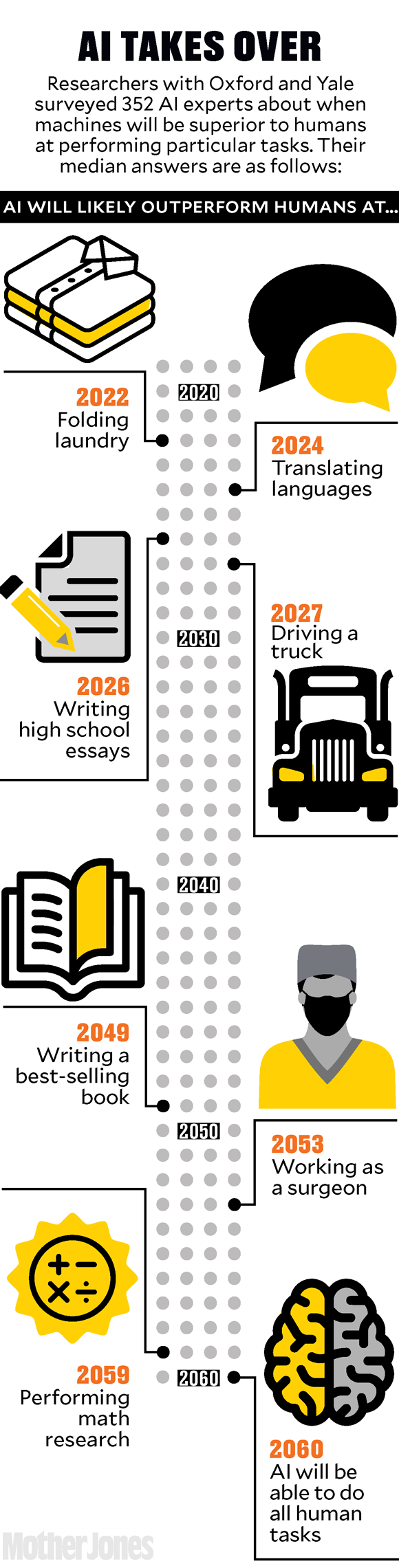
affected. In a recent paper, a team from Oxford and Yale
surveyed a large number of machine-learning researchers to produce a
“wisdom of crowds” estimate of when computers would be able to take over
various human jobs. Two-thirds said progress in machine learning had
accelerated in recent years, with Asian researchers even more optimistic
than North American researchers about the advent of full AI within 40
years.
But we don’t need full AI for everything. The machine-learning
researchers estimate that speech transcribers, translators, commercial
drivers, retail sales, and similar jobs could be fully automated during
the 2020s. Within a decade after that, all routine jobs could be gone.
Nonroutine jobs will be next: surgeons, novelists, construction
workers, police officers, and so forth. These jobs could all be fully
automated during the 2040s. By 2060, AI will be capable of performing
any task currently done by humans. This doesn’t mean that literally
every human being on the planet will be jobless by then—in fact, the
researchers suggest it could take another century before that
happens—but that’s hardly any solace. By 2060 or thereabouts, we’ll have
AI that can do anything a normal human can do, which means that nearly
all normal jobs will be gone. And normal jobs are what almost all of us
have.
2060 seems a long way off, but if the Oxford-Yale survey
is right, we’ll face an employment apocalypse far sooner than that: the
disappearance of routine work of all kinds by the mid-2030s. That
represents nearly half the US labor force. The consulting firm PricewaterhouseCoopers recently released a study
saying much the same. It predicts that 38 percent of all jobs in the
United States are “at high risk of automation” by the early 2030s, most
of them in routine occupations. In the even nearer term, the World Economic Forum predicts that the rich world will lose 5 million jobs to robots by 2020, while a group of AI experts, writing in Scientific American, figures that 40 percent of the 500 biggest companies will vanish within a decade.
Not scared yet? Kai-Fu Lee, a former Microsoft and Google executive who is now a prominent investor in Chinese AI startups, thinks artificial intelligence “will probably replace 50 percent of human jobs.” When? Within 10 years. Ten years! Maybe it’s time to really start thinking hard about AI.
And forget about putting the genie back in the bottle. AI is coming
whether we like it or not. The rewards are just too great. Even if
America did somehow stop AI research, it would only mean that the
Chinese or the French or the Brazilians would get there first. Russian
President Vladimir Putin agrees. “Artificial intelligence is the future,
not only for Russia but for all humankind,” he announced in September.
“Whoever becomes the leader in this sphere will become the ruler of the
world.” There’s just no way around it: For the vast majority of jobs,
work as we know it will come steadily to an end between about 2025 and
2060. So who benefits? The answer is
obvious: the owners of capital, who will control most of the robots. Who
suffers? That’s obvious too: the rest of us, who currently trade work
for money. No work means no money.
But things won’t actually be quite that grim. After all, fully
automated farms and factories will produce much cheaper goods, and
competition will then force down prices. Basic material comfort will be
cheap as dirt. Why Elon Musk Is Sounding the Alarm on Artificial Intelligence
Still not free, though. And capitalists can only make money if they
have someone to sell their goods to. This means that even the business
class will eventually realize that ubiquitous automation doesn’t really
benefit them after all. They need customers with money if they want to
be rich themselves.
One way or another, then, the answer to the mass unemployment of the
AI Revolution has to involve some kind of sweeping redistribution of
income that decouples it from work. Or a total rethinking of what “work”
is. Or a total rethinking of what wealth is. Let’s consider a few of
the possibilities. The welfare state writ large: This is the simplest
to think about. It’s basically what we have now, but more extensive.
Unemployment insurance will be more generous and come with no time
limits. National health care will be free for all. Anyone without a job
will qualify for some basic amount of food and housing. Higher taxes
will pay for it, but we’ll still operate under the assumption that
gainful employment is expected from anyone able to work.
This is essentially the “bury our heads in the sand” option. We
refuse to accept that work is truly going away, so we continue to punish
people who aren’t employed. Jobless benefits remain stingy so that
people are motivated to find work—even though there aren’t enough jobs
to go around. We continue to believe that eventually the economy will
find a new equilibrium.
This can’t last for too long, and millions will suffer during the
years we continue to delude ourselves. But it will protect the rich for a
while. Universal basic income #1: This is a step further
down the road. Everyone would qualify for a certain level of income from
the state, but the level of guaranteed income would be fairly modest
because we would still want people to work. Unemployment wouldn’t be as
stigmatized as it is in today’s welfare state, but neither would
widespread joblessness be truly accepted as a permanent fact of life.
Some European countries are moving toward a welfare state with cash
assistance for everyone. Universal basic income #2: This is UBI on steroids.
It’s available to everyone, and the income level is substantial enough
to provide a satisfying standard of living. This is what we’ll most
likely get once we accept that mass unemployment isn’t a sign of lazy
workers and social decay, but the inevitable result of improving
technology. Since there’s no personal stigma attached to joblessness and
no special reason that the rich should reap all the rewards of
artificial intelligence, there’s also no reason to keep the universal
income level low. After all, we aren’t trying to prod people back into
the workforce. In fact, the time will probably come when we actively
want to do just the opposite: provide an income large enough to motivate
people to leave the workforce and let robots do the job better.
Silicon Valley—perhaps unsurprisingly—is fast becoming a hotbed of
UBI enthusiasm. Tech executives understand what’s coming, and that their
own businesses risk a backlash unless we take care of its victims. Uber has shown an interest in UBI. Facebook CEO Mark Zuckerberg supports it. Ditto for Tesla CEO Elon Musk and Slack CEO
Stewart Butterfield. A startup incubator called Y Combinator is running
a pilot program to find out what happens if you give people a
guaranteed income.
There are even some countries that are now trying it. Switzerland rejected a UBI proposal in 2016, but Finland is experimenting
with a small-scale UBI that pays the unemployed about $700 per month
even after they find work. UBI is also getting limited tryouts by cities
in Italy and Canada.
Right now these are all pilot projects aimed at learning more about how
to best run a UBI program and how well it works. But as large-scale job
losses from automation start to become real, we should expect the idea
to spread rapidly. A tax on robots: This is a notion raised by a draft report to the European Parliament and endorsed by Bill Gates, who suggests
that robots should pay income tax and payroll tax just like human
workers. That would keep humans more competitive. Unfortunately, there’s
a flaw here: The end result would be to artificially increase the cost
of employing robots, and thus the cost of the goods they produce. Unless
every country creates a similar tax, it accomplishes nothing except to
push robot labor overseas. We’d be worse off than if we simply let the
robots take our jobs in the first place. Nonetheless, a robot tax could
still have value as a way of modestly slowing down job losses. Economist
Robert Shiller suggests
that we should consider “at least modest robot taxes during the
transition to a different world of work.” And where would the money go?
“Revenue could be targeted toward wage insurance,” he says. In other
words, a UBI. Socialization of the robot workforce: In this
scenario, which would require a radical change in the US political
climate, private ownership of intelligent robots would be forbidden. The
market economy we have today would continue to exist with one
exception: The government would own all intelligent robots and would
auction off their services to private industry. The proceeds would be
divided among everybody. Progressive taxation on a grand scale: Let the
robots take all the jobs, but tax all income at a flat 90 percent. The
rich would still have an incentive to run businesses and earn more
money, but for the most part labor would be considered a societal good,
like infrastructure, not the product of individual initiative. Wealth tax: Intelligent robots will be able to
manufacture material goods and services cheaply, but there will still be
scarcity. No matter how many robots you have, there’s only so much
beachfront property in Southern California. There are only so many
original Rembrandts. There are only so many penthouse suites. These
kinds of things will be the only real wealth left, and the rich will
still want them. So if robots make the rich even richer, they’ll bid up
the price of these luxuries commensurately, and all that’s left is to
tax them at high rates. The rich still get their toys, while the rest of
us get everything we want except for a view of the sun setting over the
Pacific Ocean. A hundred years from now, all of
this will be moot. Society will adapt in ways we can’t foresee, and
we’ll all be far wealthier, safer, and more comfortable than we are
today—assuming, of course, that the robots don’t kill us all, Skynet
fashion.
But someone needs to be thinking hard about how to prepare for what
happens in the meantime. Not many are. Last year, for example, the Obama White House released a 48-page report
called “Preparing for the Future of Artificial Intelligence.” That
sounds promising. But it devoted less than one page to economic impacts
and concluded only that “policy questions raised by AI-driven automation
are important but they are best addressed by a separate White House
working group.”
Regrettably, the coming jobocalypse has so far remained the prophecy
of a few Cassandras: mostly futurists, academics, and tech executives.
For example, Eric Schmidt, chairman of Google’s parent company, believes that AI is coming
faster than we think, and that we should provide jobs to everyone
during the transition. “The country’s goal should be full employment all
the time, and do whatever it takes,” he says.
Another sharp thinker about our jobless future is Martin Ford, author of Rise of the Robots.
Mass joblessness, he warns, isn’t limited to low-skill workers. Nor is
it something we can fight by committing to better education. AI will
decimate any job that’s “predictable”—which means nearly all of them.
Many of us might not like to hear this, but Ford is unsentimental about
the work we do. “Relatively few people,” he says, are paid “primarily to
engage in truly creative work or ‘blue sky’ thinking.” Roberto Parada
All this is bad enough, but it’s made worse by the fact that income
inequality has already been increasing for decades. “The frightening
reality,” Ford says, is that “we may face the prospect of a ‘perfect
storm’ where the impacts from soaring inequality, technological
unemployment, and climate change unfold roughly in parallel, and some
ways amplify and reinforce each other.” Unsurprisingly, he believes the
only plausible solution is some form of universal basic income.
So how do we get these ideas into the political mainstream? One thing
is certain: The monumental task of dealing with the AI Revolution will
be almost entirely up to the political left. After all, when the
automation of human labor begins in earnest, the big winners are
initially going to be corporations and the rich. Because of this,
conservatives will be motivated to see every labor displacement as a
one-off event, just as they currently view every drought, every
wildfire, and every hurricane as a one-off event. They refuse to see
that global warming is behind changing weather patterns because dealing
with climate change requires environmental regulations that are bad for
business and bad for the rich. Likewise, dealing with an AI Revolution
will require new ways of distributing wealth. In the long run this will
be good even for the rich, but in the short term it’s a pretty scary
prospect for those with money—and one they’ll fight zealously. Until
they have no choice left, conservatives are simply not going to admit
this is happening, let alone think about how to address it. It’s not in
their DNA.
Other candidates are equally unlikely. The military thinks about
automation all the time—but primarily as a means of killing people more
efficiently, not as an economic threat. The business community is a
slave to quarterly earnings and in any case will be too divided to be of
much help. Labor unions have good reason to care, but by themselves
they’re too weak nowadays to have the necessary clout with policymakers.
Nor are we likely to get much help from governments, which mostly
don’t even understand what’s happening. Google’s Schmidt puts it
bluntly. “The gap between the government, in terms of their
understanding of software, let alone AI, is so large that it’s almost
hopeless,” he said at a conference earlier this year. Certainly that’s
true of the Trump administration. Asked about AI being a threat to jobs,
Treasury Secretary Steven Mnuchin stunningly waved it off
as a problem that’s still 50 or 100 years in the future. “I think
we’re, like, so far away from that,” he said. “Not even on my radar
screen.” This drew a sharp rebuke from former Treasury Secretary
Larry Summers: “I do not understand how anyone could reach the
conclusion that all the action with technology is half a century away,”
he said. “Artificial intelligence is transforming everything from
retailing to banking to the provision of medical care.”
So who’s left? Like it or not, the only real choice to sound the
alarm outside the geek community is the Democratic Party, along with its
associated constellation of labor unions, think tanks, and activists.
Imperfect as it is—and its reliance on rich donors makes it
conspicuously imperfect—it’s the only national organization that has
both the principles and the size to do the job.
Unfortunately, political parties are inherently short-term thinkers.
Democrats today are absorbed with fighting President Donald Trump,
saving Obamacare, pushing for a $15 minimum wage—and arguing about all
those things. They have no time to think hard about the end of work.
Nonetheless, somebody on the left with numbers, clout, power, and
organizing energy—hopefully all the above—had better start. Conventional
wisdom says Trump’s victory last year was tipped over the edge by a
backlash among working-class voters in the Upper Midwest. When
blue-collar workers start losing their jobs in large numbers, we’ll see a
backlash that makes 2016 look like a gentle breeze. Either liberals
start working on answers now, or we risk voters rallying around far more
effective and dangerous demagogues than Trump.
Despite the amount of media attention that both robots and AI have
gotten over the past few years, it’s difficult to get people to take
them seriously. But start to pay attention and you see the signs: An
Uber car can drive itself. A computer can write simple sports stories. SoftBank’s Pepper robot already works
in more than 140 cellphone stores in Japan and is starting to get
tryouts in America too. Alexa can order replacement Pop-Tarts before you
know you need them. A Carnegie Mellon computer
that seems to have figured out human bluffing beat four different
online-poker pros earlier this year. California, suffering from a lack
of Mexican workers, is ground zero for the development of robotic crop
pickers. Sony is promising a robot that will form an emotional bond with
its owner.
These are all harbingers, the way a dropping barometer signals a
coming storm—not the possibility of a storm, but the inexorable reality.
The two most important problems facing the human race right now are the
need for widespread deployment of renewable energy and figuring out how
to deal with the end of work. Everything else pales in comparison.
Renewable energy already gets plenty of attention, even if half the
country still denies that we really need it. It’s time for the end of
work to start getting the same attention.
Innovation in artificial intelligence and robotics could force
governments to legislate for quotas of human workers, upend traditional
working practices and pose novel dilemmas for insuring driverless cars,
according to a report by the International Bar Association.
The survey, which suggests that a third of graduate level jobs around
the world may eventually be replaced by machines or software, warns
that legal frameworks regulating employment and safety are becoming
rapidly outdated.
The competitive advantage of poorer, emerging economies – based on
cheaper workforces – will soon be eroded as robot production lines and
intelligent computer systems undercut the cost of human endeavour, the
study suggests.
While a German car worker costs more than €40 (£34) an hour, a robot
costs between only €5 and €8 per hour. “A production robot is thus
cheaper than a worker in China,” the report notes. Nor does a robot “become ill, have children or go on strike and [it] is not entitled to annual leave”.
The 120-page report, which focuses on the legal implications of rapid
technological change, has been produced by a specialist team of
employment lawyers from the International Bar Association, which acts as
a global forum for the legal profession.
The report covers both changes already transforming work and the
future consequences of what it terms ‘industrial revolution 4.0’. The
three preceding revolutions are listed as: industrialisation,
electrification and digitalisation. ‘Industry 4.0’ involves the
integration of the physical and software in production and the service
sector. Amazon, Uber, Facebook, ‘smart factories’ and 3D printing, its
says, are among current pioneers.
Current Time 0:00
/
Duration Time 0:00
Loaded: 0%
Progress: 0%
Mute
Robots can predict the future … and so can youThe report’s lead author, Gerlind Wisskirchen – an employment lawyer
in Cologne who is vice-chair of the IBA’s global employment institute,
said: “What is new about the present revolution is the alacrity with
which change is occurring, and the broadness of impact being brought
about by AI and robotics.
“Jobs at all levels in society presently undertaken by humans are at
risk of being reassigned to robots or AI, and the legislation once in
place to protect the rights of human workers may be no longer fit for
purpose, in some cases ... New labour and employment legislation is
urgently needed to keep pace with increased automation.”
Peering into the future, the authors suggest that governments will
have to decide what jobs should be performed exclusively by humans – for
example, caring for babies. “The state could introduce a kind of ‘human
quota’ in any sector,” and decide “whether it intends to introduce a
‘made by humans’ label or tax the use of machines,” the report says.
Increased mechanical autonomy will cause problems of how to define
legal responsibility for accidents involving new technology such as
driverless cars. Will it be the owner, the passengers, or manufacturers
who pay the insurance?
“The liability issues may become an insurmountable obstacle to the
introduction of fully automated driving,” the study warns. Driverless
forklifts are already being used in factories. Over the past 30 years
there have been 33 employee deaths caused by robots in the US, it notes.
Limits, it says, will have to be imposed on some aspects of machine
autonomy. The study adopts the military principle, endorsed by the
Ministry of Defence, that there must always be a ‘human in the loop’ to
prevent the development and deployment of entirely autonomous drones
that could be programmed to select their own targets.
“A no-go area in the science of AI is research into intelligent
weapon systems that open fire without a human decision having been
made,” the report states. “The consequences of malfunctions of such
machines are immense, so it is all the more desirable that not only the
US, but also the United Nations discusses a ban on autonomous weapon
systems.”
The term ‘artificial intelligence’ (AI) was first coined by the
American computer scientist John McCarthy in 1955. He believed that
“every aspect of learning or any other feature of intelligence can in
principle be so precisely described that a machine can be made to
simulate it.” Software developers are still attempting to achieve his
goal.
The gap between economic reality in the self-employed ‘gig economy’
and existing legal frameworks is already growing, the lawyers note. The
new information economy is likely to result in more monopolies and a
greater income gap between rich and poor because “many people will end
up unemployed, whereas highly qualified, creative and ambitious
professionals will increase their wealth.”
Among the professions deemed most likely to disappear are accountants, court clerks and ‘desk officers at fiscal authorities’.
Even some lawyers risk becoming unemployed. “An intelligent algorithm
went through the European Court of Human Rights’ decisions and found
patterns in the text,” the report records. “Having learned from these
cases, the algorithm was able to predict the outcome of other cases with
79% accuracy ... According to a study conducted by [the auditing firm]
Deloitte, 100,000 jobs in the English legal sector will be automated in
the next 20 years.”
The pioneering nation in respect of robot density in the industrial
sector is South Korea, which has 437 robots for every 10,000 employees
in the processing industry, while Japan has 323 and Germany 282. Robots
may soon invade our home and leisure environments. In the ‘Henn-na
Hotel’ in Sasebo, Japan, ‘actroids’ – robots with a human likeness – are
deployed, the report says. “In addition to receiving and serving the
guests, they are responsible for cleaning the rooms, carrying the
luggage and, since 2016, preparing the food.”
The robots are able to respond to the needs of the guests in three
languages. The hotel’s plan is to replace up to 90% of the employees by
using robots in hotel operations with a few human employees monitoring
CCTV cameras to see whether they need to intervene if problems arise.
The traditional workplace is disintegrating, with more part time
employees, distance working, and the blurring of professional and
private time, the report observes. It is being replaced by “the ‘latte
macchiato’ workplace where employees or freelance workers in the cafe
around the corner, working from their laptops.”
The workplace may eventually only serve the purpose of maintaining social network between colleagues.
We made a choice…
… and we want to tell you about it. Our journalism
now reaches record numbers around the world and more than a million
people have supported our reporting. We continue to face financial
challenges but, unlike many news organisations, we haven’t put up a
paywall. We want our journalism to remain accessible to all, regardless
of where they live or what they can afford. This is The Guardian’s model for open, independent journalism: free for those who can’t afford it, supported by those who can.
Readers’ support powers our work, safeguarding our essential editorial
independence. This means the responsibility of protecting independent
journalism is shared, enabling us all to feel empowered to bring about
real change in the world. Your support gives Guardian journalists the
time, space and freedom to report with tenacity and rigour, to shed
light where others won’t. It emboldens us to challenge authority and
question the status quo. And by keeping all of our journalism free and
open to all, we can foster inclusivity, diversity, make space for
debate, inspire conversation – so more people have access to accurate
information with integrity at its heart.
Guardian journalism is
rooted in facts with a progressive perspective on the world. We are
editorially independent, meaning we set our own agenda. Our journalism
is free from commercial bias and not influenced by billionaire owners,
politicians or shareholders. No one steers our opinion. At a time when
there are so few sources of information you can really trust, this is
vital as it enables us to give a voice to those less heard, challenge
the powerful and hold them to account. Your support means we can keep
investigating and exploring the critical issues of our time.
Our
model allows people to support us in a way that works for them. Every
time a reader like you makes a contribution to The Guardian, no matter
how big or small, it goes directly into funding our journalism. But we
need to build on this support for the years ahead. Support The Guardian from as little as $1 – and it only takes a minute. Thank you.
An open letter
calling for a ban on lethal weapons controlled by artificially
intelligent machines was signed last week by thousands of scientists and
technologists, reflecting growing concern that swift progress in
artificial intelligence could be harnessed to make killing machines more
efficient, and less accountable, both on the battlefield and off. But
experts are more divided on the issue of robot killing machines than you
might expect. The letter, presented at the International Joint Conference on Artificial Intelligence
in Buenos Aires, Argentina, was signed by many leading AI researchers
as well as prominent scientists and entrepreneurs including Elon Musk,
Stephen Hawking, and Steve Wozniak. The letter states: “Artificial Intelligence (AI) technology has reached a point
where the deployment of such systems is—practically if not
legally—feasible within years not decades, and the stakes are high:
autonomous weapons have been described as the third revolution in
warfare, after gunpowder and nuclear arms.”
Rapid advances have indeed been made in artificial intelligence in
recent years, especially within the field of machine learning, which
involves teaching computers to recognize often complex or subtle
patterns in large quantities of data. And this is leading to ethical
questions about real-world applications of the technology (see “How to Make Self-Driving Cars Make Ethical Decisions”).
Meanwhile, military technology has advanced to allow actions to be
taken remotely, for example using drone aircraft or bomb disposal
robots, raising the prospect that those actions could be automated.
The issue of automating lethal weapons has been a concern for
scientists as well as military and policy experts for some time. In
2012, the U.S. Department of Defense issued a directive
banning the development and use of “autonomous and semi-autonomous”
weapons for 10 years. Earlier this year the United Nations held a
meeting to discuss the issue of lethal automated weapons, and the
possibility of such a ban.
But while military drones or robots could well become more
automated, some say the idea of fully independent machines capable
carrying out lethal missions without human assistance is more fanciful.
With many fundamental challenges still remaining in the field of
artificial intelligence, however, it’s far from clear when the
technology needed for fully autonomous weapons might actually arrive.
“We’re pushing new frontiers in artificial intelligence,” says Patrick Lin,
a professor of philosophy at California Polytechnic State University.
“And a lot of people are rightly skeptical that it would ever advance to
the point where it has anything called full autonomy. No one is really
an expert on predicting the future.”
Lin, who gave evidence at the recent U.N. meeting, adds that the
letter does not touch on the complex ethical debate behind the use of
automation in weapons systems. “The letter is useful in raising
awareness,” he says, “but it isn’t so much calling for debate; it’s
trying to end the debate, saying ‘We’ve figured it out and you all need
to go along.’” Stuart Russell,
a leading AI researcher and a professor at the University of
California, Berkeley, dismisses this idea. “It’s simply not true that
there has been no debate,” he says. “But it is true that the AI and
robotics communities have been mostly blissfully ignorant of this issue,
maybe because their professional societies have ignored it.”
One issue of debate, which the letter does acknowledge, is that
automated weapons could conceivably help reduce unwanted casualties in
some situations, since they would be less prone to error, fatigue, or
emotion than human combatants.
Those behind the letter have little time for this argument, however. Max Tegmark, an MIT physicist and founder member of the Future of Life Institute,
which coördinated the letter signing, says the idea of ethical
automated weapons is a red herring. “I think it’s rather irrelevant,
frankly,” he says. “It’s missing the big point about what is this going
to lead to if one starts this AI arms race. If you make the assumption
that only the U.S. is going to build these weapons, and the number of
conflicts will stay exactly the same, then it would be relevant.”
The Future of Life Institute has issued a more general warning
about the long-term risks posed by unfettered AI, cautioning that it
could pose serious dangers in the future.
“This is quite a different issue,” Russell says. “Although there is
a connection, in that if one is worried about losing control over AI
systems as they become smarter, maybe it’s not a good idea to turn over
our defense systems to them.”
While many AI experts seem to share this broad concern, some see it as a little misplaced. For example, Gary Marcus, a cognitive scientist and artificial intelligence researcher at New York University, has argued
that computers do not need to become artificially intelligent in order
to pose many other serious risks, to financial markets or air-traffic
systems, for example.
Lin says that while the concept of unchecked killer robots is
obviously worrying, the issue of automated weapons deserves a more
nuanced discussion. “Emotionally, it’s a pretty straightforward case,”
says Lin. “Intellectually I think they need to do more work.”
The age of the Internet grants anyone who can access it an
opportunity to learn a great deal about virtually anything in a short
amount of time. Unfortunately, the published information can be
incorrect. Anyone who Googles "The John Birch Society" will see this
problem demonstrated almost immediately. From the slanted view given of
the Society at Wikipedia to the crazed rantings of detractors, much of
the information provided is either distorted or downright false. Thus,
we offer this page where we seek to set the record straight.
Myth: The JBS is a radical organization full of right-wing extremists.-
Fact: The JBS is dedicated to restoring the Republic according to the
vision of the Founding Fathers: limited government, individual liberty,
and the rule of law. Along with America's Founders, we believe that
governments are instituted to protect individual rights and liberties,
and are not formed to provide for the wants of individuals. To label JBS
radical or extreme for agreeing with our nation's Founders is to place
that same label on them.
Myth: The JBS message is hate-filled.-
Fact: There never has been any hate in our agenda and it will never
be employed as a tactic. From the outset, membership in JBS has been
strictly denied to haters and, should any member adopt a racist or
anti-Semitic attitude or behavior, the membership of such a person will
be permanently revoked.
Myth: The JBS Founder Robert Welch called President Dwight Eisenhower a Communist.-
Fact: Originally detailing some of Pres. Eisenhower's history in a
1954 letter sent privately to a few friends, Mr. Welch's research grew
over several years into a full-length book entitled The Politician
(1963). Once the book was published, its very existence was ignored
while critics continued to dwell on only one of several possible
conclusions offered by Mr. Welch.The book provides 300 pages and 150
pages of footnotes and documentation, including covering one of Mr.
Eisenhower's most immoral and despicable acts of authorizing "Operation
Keelhaul"; which used American soldiers to repatriate anti-communist
Poles to their certain death or torture. Read the book for yourself and
discover what Mr. Welch did say and learn the role played by Mr.
Eisenhower over his many years as one of our nation's military and
political leaders.
Myth: The JBS considers public water fluoridation part of a Communist mind-control plot.-
Fact: While the JBS doesn't agree with water fluoridation because it
is a form of government mass medication of citizens in violation of
their individual right to choose which medicines they ingest, it was
never opposed as a mind-control plot. If citizens want to add fluoride
to their diet or daily routine, there are plentiful opportunities for
them to do so. It’s a choice they should make, not their local
government. Furthermore, opposition to fluoridation was never a major
action item of any JBS campaign.
Myth: The JBS is nothing more than a group of conspiracy theorists.-
Fact: The John Birch Society reports on those that create and
influence public policy and the motivations behind their actions. JBS
directs members to counter unconstitutional actions through peaceful,
educational means, including supporting or blocking legislation, setting
up relationships with key elected officials and local leaders, and
holding elected officials accountable to their oath of office. By
definition, a conspiracy exists when two or more persons work secretly
for an evil or unlawful purpose. Given the state that America is in
today, one could argue that an unconstitutional agenda is no longer
secret, but in the open for all to see. Those that continue to work
against the Constitution do so brazenly, continuing to make promises and
entitlements to citizens that the country cannot afford while
committing future generations to crushing debt and ever decreasing
prosperity at the expense of liberty.
Myth: The JBS was booted out of the conservative movement by William F. Buckley.-
Fact: In the mid-1950s on more than one occasion, John Birch Society
Founder Robert Welch financially helped an up-and-coming conservative
leader, and recommended that others do the same, so this rising young
star could get his new magazine off the ground. That newcomer was
William F. Buckley and his magazine was National Review. A few short
years later, Mr. Buckley attacked Robert Welch in a lengthy article in
his magazine. Over the past several decades, Buckley carried out a
campaign of attacking or disparaging Welch and the Society. On numerous
occasions, he boasted to friends that he intended to destroy The John
Birch Society. He didn't succeed. Read more in John McManus' book,
William F. Buckley: Pied Piper for the Establishment.
Myth: The JBS is against civil rights because it opposed several Civil Rights acts.-
Fact: Correcting civil rights abuses that do exist should be
accomplished at the state and local level, something The John Birch
Society members - of all races, colors and ethnic backgrounds - have
always supported. Civil rights legislation should have come from the
states and the communities rather than being used as a steppingstone
toward our present-day out-of-control federal government.
Myth: The JBS is nothing more than controlled opposition,
pretending to be a friend to the cause of liberty. Robert Welch sold his
candy company to the leftist, internationalist Rockefellers.-
Fact: Robert Welch was out of the candy manufacturing business
(retiring in 1956) when his brother (for whom he used to work) sold the
James O. Welch Candy company to Nabisco in 1963. JBS has never been
funded by any Rockefeller money. Nelson Rockefeller publicly attacked
JBS, and JBS has exposed the Rockefeller support for the United Nations
and its goal of a new world order more than any other organization.
Myth: The John Birch Society played a role in the assassination of President Kennedy.-
Fact: This is perhaps the most despicable myth. The truth is that The
John Birch Society has always lived by the age-old adage that foul
means can never be employed to accomplish a goal, no matter how
important that goal. While JBS and its members called attention to the
many dangerous and unconstitutional acts and programs promoted by
President Kennedy, it has always been the Society’s position that
anything harmful to our country emanating from the White House should be
countered by congressional or judicial action urged upon our nation’s
leaders by concerned American citizens. Immediately after the
assassination, founder Robert Welch canceled the “For God and Country”
rally that thousands had committed to attend in Boston the following
day. He then sent a telegram of condolences to Mrs. Kennedy. In that
brief message, published by the Boston Globe on November 23, 1963,
Robert Welch stated: “On behalf of the Council of the John Birch Society
and myself, I wish to express our deep sorrow at the untimely loss to
our nation of its youngest elected President and to convey more
particularly to you and all members of President Kennedy’s family our
sincere and heartfelt sympathy in your overwhelming personal loss.
In a recently leaked memo, the FBI has confirmed the existence of
extraterrestrial life, though the claim is now being denied by the
bureau. However, despite their denial, there is still plenty of evidence
that is out there that shows that aliens do in fact exist and they have
visited our planet, possibly for quite some time. The memo is from the
early 1950’s and talks about a UFO being discovered by the government in
New Mexico. Of course, in typical fashion the FBI has denied it,
claiming it to be a fabricated hoax designed to mislead the public, but
we know better now. More and more evidence is coming out that proves
UFO’s exist and that we have been visited by alien lifeforms.
A recent video from the government shows footage of fighter pilots
encountering a UFO with a disk-like shape. The fact that the government
would even release such footage is proof enough that there are aliens
out there interacting with humans, and based on how advanced their
flight technology is, they have been visiting us for quite some time.
Watch the video closely and you will notice that the disk-like object
moves in a way that a normal aircraft could not, and there is no other
explanation than the object being an advanced piece of alien technology
that is well beyond our comprehension.
The Secret Pentagon UFO Program
When you think about it, it makes total sense that our government has
been lying to us. If the public knew about what was really going on
behind closed doors with regards to alien life, we would collectively
freak out.
Additionally, a former top Pentagon official confirmed the existence
of a top-secret government program to track UFO’s, called the Advanced
Aviation Threat Identification Program. The former Pentagon official,
Luis Elizondo, recently spoke with CNN about the inner workings of the
program and how the unidentified aircraft discovered by the program is
unlike anything that has ever been seen on earth. He went on to explain
that these aircraft could seemingly defy the laws of aerodynamics and
contained advanced technology. Here we have a former government worker
finally telling us the truth and confirming our long-held suspicions.
The Pentagon tried to hide the existence of this program, despite the
fact that it received over 22 million dollars annually as part of the
budget, but now we know the truth.
The American public is scared to admit that these cases continue to
crop up and that the alien visitations are increasing in number and
stature. Tom DeLonge, known for his work in Blink-182, quit the band so
that he could focus all of his energy on proving the aliens exist. Tom
has gotten himself into deep trouble with the government, but he has
overwhelming evidence that supports the fact that we have been visited
by aliens. He recently went on the Joe Rogan podcast to talk about it.
Tom is staking his professional career on finding evidence that aliens
exist and that our government has been concealing their existence for
quite some time.
CIA Releases Over 13 Million Pages of Declassified Documents
The CIA recently released over 13 million pages worth of previously
classified documents, with many of them talking about the existence of
UFO’s. How can it be a conspiracy when both the FBI and CIA talk about
UFO’s and alien technology? It is clear that they are withholding even
more material than what has been released. The fact that they
continually reference UFO’s in these documents is yet another piece of
evidence that proves aliens exist and have visited our planet recently.
Detractors who have labeled these truth seekers as conspiracy theorists
will be happy to know that the declassified documents also show the
existence of the CIA’s Stargate program, which attempted to use the
power of psychic phenomena for use in military and espionage. For a long
time, many people refused to believe the program existed, labeling it
as a conspiracy theory. However, the truth will always see the light, so
it was only a matter of time before these revelations became public.
The Truth About Aliens and UFO’S
There are too many UFO and alien sightings for it just to be a
misidentification or a hallucination unless of course, the chemicals the
government is poisoning us with are causing us to hallucinate, which is
possible. A more plausible reason is that our technology is advancing
at a high rate and now aliens wish to have more contact with us. It
always amazed me that so many people in this country were so quick to
dismiss any UFO sightings as an optical illusion or some
misidentification of an aircraft, come on. The American public has been
lied to for long enough, and now the truth is beginning to come out, and
there is nothing that the government can do to stop this.
We have seen an unpreceded explosion in information being released to
the public in recent years, and now the information that was once
inaccessible to most of the nation is available to everyone.
Extraterrestrial life exists, one only has to think about the enormity
of the universe to realize we are not alone, and now more and more
evidence continues to come out that proves this is a fact. It really
does make you think about what else the government has been hiding from
us, and what other secrets will finally be revealed.