Picking his way through the Soviet archives that Boris Yeltsin had
just thrown open, in 1991 Tim Sebastian, a reporter for the London Times,
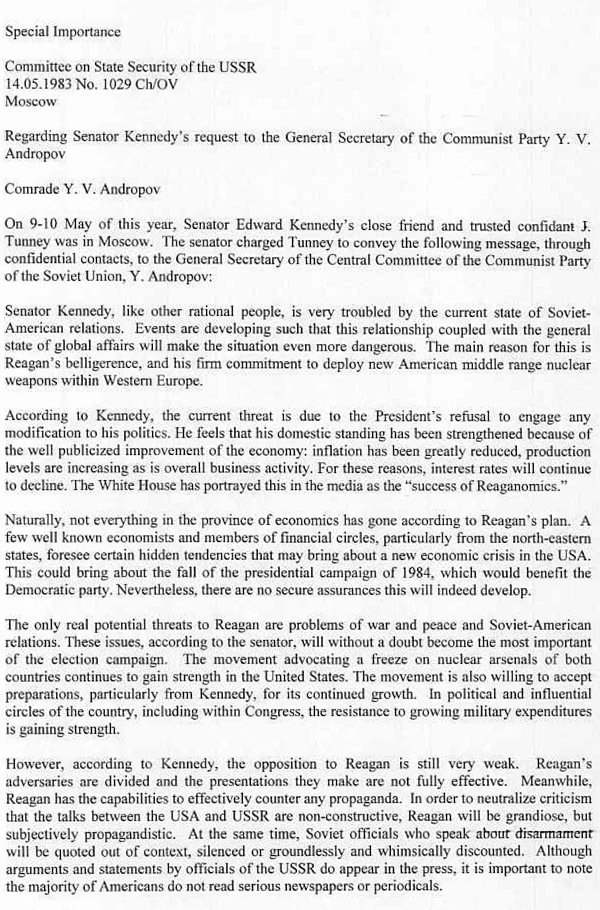
came across an arresting memorandum. Composed in 1983 by Victor
Chebrikov, the top man at the KGB, the memorandum was addressed to Yuri
Andropov, the top man in the entire USSR. The subject: Sen. Edward
Kennedy.
“On 9-10 May of this year,” the May 14 memorandum explained, “Sen. Edward Kennedy’s close friend and trusted confidant [John] Tunney was in Moscow.” (Tunney was Kennedy’s law school roommate and a former Democratic senator from California.) “The senator charged Tunney to convey the following message, through confidential contacts, to the General Secretary of the Central Committee of the Communist Party of the Soviet Union, Y. Andropov.”
Kennedy’s message was simple. He proposed an unabashed quid pro quo. Kennedy would lend Andropov a hand in dealing with President Reagan. In return, the Soviet leader would lend the Democratic Party a hand in challenging Reagan in the 1984 presidential election. “The only real potential threats to Reagan are problems of war and peace and Soviet-American relations,” the memorandum stated. “These issues, according to the senator, will without a doubt become the most important of the election campaign.”
Kennedy made Andropov a couple of specific offers.
First he offered to visit Moscow. “The main purpose of the meeting, according to the senator, would be to arm Soviet officials with explanations regarding problems of nuclear disarmament so they may be better prepared and more convincing during appearances in the USA.” Kennedy would help the Soviets deal with Reagan by telling them how to brush up their propaganda.
Then he offered to make it possible for Andropov to sit down for a few interviews on American television. “A direct appeal … to the American people will, without a doubt, attract a great deal of attention and interest in the country. … If the proposal is recognized as worthy, then Kennedy and his friends will bring about suitable steps to have representatives of the largest television companies in the USA contact Y.V. Andropov for an invitation to Moscow for the interviews. … The senator underlined the importance that this initiative should be seen as coming from the American side.”
Kennedy would make certain the networks gave Andropov air time–and that they rigged the arrangement to look like honest journalism.
Kennedy’s motives? “Like other rational people,” the memorandum explained, “[Kennedy] is very troubled by the current state of Soviet-American relations.” But that high-minded concern represented only one of Kennedy’s motives.
“Tunney remarked that the senator wants to run for president in 1988,” the memorandum continued. “Kennedy does not discount that during the 1984 campaign, the Democratic Party may officially turn to him to lead the fight against the Republicans and elect their candidate president.”
Kennedy proved eager to deal with Andropov–the leader of the Soviet Union, a former director of the KGB and a principal mover in both the crushing of the 1956 Hungarian Revolution and the suppression of the 1968 Prague Spring–at least in part to advance his own political prospects.
In 1992, Tim Sebastian published a story about the memorandum in the London Times. Here in the U.S., Sebastian’s story received no attention. In his 2006 book, The Crusader: Ronald Reagan and the Fall of Communism, historian Paul Kengor reprinted the memorandum in full. “The media,” Kengor says, “ignored the revelation.”
“The document,” Kengor continues, “has stood the test of time. I scrutinized it more carefully than anything I’ve ever dealt with as a scholar. I showed the document to numerous authorities who deal with Soviet archival material. No one has debunked the memorandum or shown it to be a forgery. Kennedy’s office did not deny it.”
Why bring all this up now? No evidence exists that Andropov ever acted on the memorandum–within eight months, the Soviet leader would be dead–and now that Kennedy himself has died even many of the former senator’s opponents find themselves grieving. Yet precisely because Kennedy represented such a commanding figure–perhaps the most compelling liberal of our day–we need to consider his record in full.
Doing so, it turns out, requires pondering a document in the archives of the politburo.
When President Reagan chose to confront the Soviet Union, calling it the evil empire that it was, Sen. Edward Kennedy chose to offer aid and comfort to General Secretary Andropov. On the Cold War, the greatest issue of his lifetime, Kennedy got it wrong.
“On 9-10 May of this year,” the May 14 memorandum explained, “Sen. Edward Kennedy’s close friend and trusted confidant [John] Tunney was in Moscow.” (Tunney was Kennedy’s law school roommate and a former Democratic senator from California.) “The senator charged Tunney to convey the following message, through confidential contacts, to the General Secretary of the Central Committee of the Communist Party of the Soviet Union, Y. Andropov.”
Kennedy’s message was simple. He proposed an unabashed quid pro quo. Kennedy would lend Andropov a hand in dealing with President Reagan. In return, the Soviet leader would lend the Democratic Party a hand in challenging Reagan in the 1984 presidential election. “The only real potential threats to Reagan are problems of war and peace and Soviet-American relations,” the memorandum stated. “These issues, according to the senator, will without a doubt become the most important of the election campaign.”
Kennedy made Andropov a couple of specific offers.
First he offered to visit Moscow. “The main purpose of the meeting, according to the senator, would be to arm Soviet officials with explanations regarding problems of nuclear disarmament so they may be better prepared and more convincing during appearances in the USA.” Kennedy would help the Soviets deal with Reagan by telling them how to brush up their propaganda.
Then he offered to make it possible for Andropov to sit down for a few interviews on American television. “A direct appeal … to the American people will, without a doubt, attract a great deal of attention and interest in the country. … If the proposal is recognized as worthy, then Kennedy and his friends will bring about suitable steps to have representatives of the largest television companies in the USA contact Y.V. Andropov for an invitation to Moscow for the interviews. … The senator underlined the importance that this initiative should be seen as coming from the American side.”
Kennedy would make certain the networks gave Andropov air time–and that they rigged the arrangement to look like honest journalism.
Kennedy’s motives? “Like other rational people,” the memorandum explained, “[Kennedy] is very troubled by the current state of Soviet-American relations.” But that high-minded concern represented only one of Kennedy’s motives.
“Tunney remarked that the senator wants to run for president in 1988,” the memorandum continued. “Kennedy does not discount that during the 1984 campaign, the Democratic Party may officially turn to him to lead the fight against the Republicans and elect their candidate president.”
Kennedy proved eager to deal with Andropov–the leader of the Soviet Union, a former director of the KGB and a principal mover in both the crushing of the 1956 Hungarian Revolution and the suppression of the 1968 Prague Spring–at least in part to advance his own political prospects.
In 1992, Tim Sebastian published a story about the memorandum in the London Times. Here in the U.S., Sebastian’s story received no attention. In his 2006 book, The Crusader: Ronald Reagan and the Fall of Communism, historian Paul Kengor reprinted the memorandum in full. “The media,” Kengor says, “ignored the revelation.”
“The document,” Kengor continues, “has stood the test of time. I scrutinized it more carefully than anything I’ve ever dealt with as a scholar. I showed the document to numerous authorities who deal with Soviet archival material. No one has debunked the memorandum or shown it to be a forgery. Kennedy’s office did not deny it.”
Why bring all this up now? No evidence exists that Andropov ever acted on the memorandum–within eight months, the Soviet leader would be dead–and now that Kennedy himself has died even many of the former senator’s opponents find themselves grieving. Yet precisely because Kennedy represented such a commanding figure–perhaps the most compelling liberal of our day–we need to consider his record in full.
Doing so, it turns out, requires pondering a document in the archives of the politburo.
When President Reagan chose to confront the Soviet Union, calling it the evil empire that it was, Sen. Edward Kennedy chose to offer aid and comfort to General Secretary Andropov. On the Cold War, the greatest issue of his lifetime, Kennedy got it wrong.


