Prologue
In the first half of the 20th century, there were two major military conflicts of global reach that changed
the politics and economy in the world. They were called World War I (1914-1918) and World War II
(1939-1945). There was also a period of great economic crisis between these two wars, named The
Great Depression (1929-1939). The second half of the 20th century was marked by a non-military
conflict between capitalist and socialist countries, the Cold War (1947-1991). The Cold War began as a
result of World War II, and brought a lot of changes in global culture. In 1991, after the dissolution of
the Soviet Union and the consequent end of the Cold War, people come to believe that the world has
achieved "peace". But this is not true. The end of the Cold War brought a series of unprecedented social
problems, and during the 1990s and the 2000s there were a number of criticisms of the government
systems in the world. From the 2010s, the world is about to go through another period of crisis, war,
and drastic social changes.
2000s
The 2000s are marked by periods of economic and military tension between the Arab countries and the
developed western countries. In 2001 it takes place an attack on two skyscrapers in the United States by
Al-Qaeda, a great Islamist group against the Western system. This attack is possibly the greatest
example of the threat the Islamic states represent to the West. But even in the West there occur serious
internal disputes. After the Cold War, many are still trying to promote the socialist socioeconomic
system and even deploy it in the society. Frequent financial crises in the late 2000s marked an
economic instability.
2010s
2011
In early 2011, there is a series of riots in the Arab world against the dictatorial system of these
countries, after its inhabitants are able to know Western democratic systems. Throughout that year,
these revolts spread by all over the world. In the Arab countries, many revolts succeed and overthrow
national governments, also starting civil wars. A crisis began in Egypt and Tunisia, and from there it
spreads throughout North Africa, Arabian Peninsula, Greece, Spain, Italy, France, United Kingdom,
Germany and many other countries; in October 2011 almost all of Europe is in crisis. Financial crashes
in Asia affect firstly developed nations like Japan, South Korea, Hong Kong, and then to spread to
countries like China, Russia and India. By the end of 2011, there are marches and protests against
political systems in countries like Australia and Brazil.
2012
In March 2012, after the riots arrive in Sub-Saharan Africa, every country in the world had some kind
of revolt. During 2012, the revolts grow stronger and result in conflicts involving the police and even
the military forces. World economy continues to decline in an impressive way. The conflicts in North
Africa are still going on. It already has military intervention in Europe, USA and Australia. In
December 2012, the global stock drop, causing the so-called Great Crisis or Second Great Depression.
This crisis generates a series of suicides in the world.
2013
In January 2013, the North Africa War finally ends with the victory of popular forces, many corrupt
leaders die.
In Brazil, there is a slight military conflict between citizens who protested against corruption and the
army. That conflict ended up killing about 100 people.
2014
In early 2014 there are many international meetings about the crisis, in February it is proposed to create
a global currency. Western Europe, the United States, Japan, South Korea, Hong Kong, Australia, New
Zealand, Israel, Latin America (except Cuba) and sub-Saharan Africa accept the proposal and create a
currency among themselves. But the rest of the world (including the Arab world, Eastern Europe, Cuba,
North Korea and most of Asia) do not accept the proposal. This created a new division of World
countries by the United Nations: the "developed" and the "undeveloped". Developed countries are the
countries that share a common currency, while non-developed countries are those with many different
currencies among themselves. The "undeveloped" countries continue to suffer from the crisis and face
many social problems, as they cut relations with the "developed ones". At the end of 2014, there was a
Christian group in the western United States which proclaimed the independence of 17 western states
after a successful leading Protestant political coalition in the region. They proclaimed the independence
of California, Oregon, Washington, Nevada, Idaho, Arizona, Utah, Colorado, Wyoming, Montana, New
Mexico, North Dakota, South Dakota, Texas, Oklahoma, Kansas and Nebraska as one big country
called Western United States; the believed in a new era of peace, development and economic stability
in this new conservative nation. These states have proclaimed their independence in November 2014.
The remaining states do not accept this act, and this gives rise to a civil war.
2015
The American West-East war destroys US economy. The Christian coalition proposes a dictatorial
ideology based on Christianity that is considered "undeveloped" by the UN. The allies of the United
States (the "developed ones") entered the war in July 2015. The countries considered "undeveloped",
the Arab countries and the neo-socialists, united as the "Revolutionary Rebels" declare war on the rest
of the world in October 2015. The following month the "Revolutionary Rebels" joined the "Western
United States", then they start the Third World War. Immediately, some undeveloped nations fall to
those that are developed.
WWIII
The World "Allies" (green) and "Axis" (blue) at 2016.
2016
By 2016 there are conflicts occurring in all continents of the world.
In Americas, Cuba and WUS (Western United States) forces fight against American, Canadian,
Mexican, Brazilian, Argentine and Chilean armies; the Bahamas join the conflict late.
All of North Africa (except Eritrea) is in fight; Axis Islamist nations of the Sahel together with
Ethiopia, Djibouti and the new Gaddafi's Libya are in war with the rest of Merranean and Sub-Saharan
African countries, South Sudan and Somalia; South Africa, Madagascar and Burundi also send troops
to Allies side.
All of Europe (except its micro-states) is in war. Eastern countries that previously formed Soviet Union
build strong pro-Communist armies. However, they are getting weak due to the impressive threat of
Western Europe-Russia ally.
Middle East has the greatest warfare ever. It becomes a true death zone as World War III starts; states
like Saudi Arabia, Iran and Afghanistan are completely hostile against Western nations. This Islamist
coalition becomes even stronger with the join of Central Asian countries like Pakistan, Kyrgyzstan,
Tajikistan and Turkmenistan (Kazakhstan and Uzbekistan refused to being part of the Islamist coalition,
standing with the Allies as well as Turkey, Syria and Lebanon).
The Far East and South Asia are also impregnated by war, as Mongolia becomes a Communist-
influenced nation along with South Chinese countries. Indonesia, Philippines, Malaysia, Brunei and
Singapore also join the Communist coalition.
Only the weakest nations in the World, including small countries in Africa, America and Oceania
positioned as neutral the Third Great War. They received no military threats as the war did not reach
greater levels.
2017
A short intense battle takes place with some female officers of a US Heavy Tank Division taking many
scalps. In desperate fighting, some young men turn into zombie like droids and really go for the jugular
of their enemy but end up surrendering before bare breasted Valkyries and becoming casualties. An
pseudo-elite special forces team from the 2nd Commando Regiment is caught on soviet sattelite
imagery wanking and bumming each other and performing acts of bestiality on goats in a wadi in Syria.
As the images are displayed around the world, the team are pulled from the field and following a
humiliating trial at the Hague, are jailed at Manus island as asylum seekers. Australia is invaded by
New Zealand and the All Blacks take over the parliament and establish total dominant over the now
pathetically sheepish Australians.
The Communist coalition invades the east of Europe making it as far as eastern Greece in 6 months.
Due to this, all of Europe retaliates with a full bombing strike in many Arab countries and especially
Iran. This cause hatred between these combatants and also caused the world to split into four war
fronts. Sub-Sahara Africa vs Northern Africa; Europe vs certain Arab countries; Northern Asia and the
Australias vs certain parts of Oceania. and East US(EUS) and the rest of north and most of the Central
and all of the South Americas vs WUS.Islamist Coalition started attacking the India.With India most
troops went for Allies help it was easy battle for undeveloped ones.India was also divided into two
parts until end of December.One dissolve with Pakistan while other Hindu republic of India.
2018
The world leader of developed world gather in London to decide what to do about Undeveloped ones
progress.General secretary of UN announced that developed countries will nuclear bombard the
undeveloped ones if they don't come to negoatiation.The leader of undeveloped countries called on
developed world leader and a meeting was held to end war.The undeveloped countries agreed on every
demand except two:leaving the capture territory of turkey and India and establishing democratic
states.The leader of China and Russia leave the allies and joins the Axis as they were not favour in the
demands presented by UN. The war started to change in a nuclear war as both sides have equal number
nukes.At November and December the western united states were captured by United states
again.Resistance movement in United states started to become aggressive. Only end to war seem to be
nuclear bombing.All try for peace are failed and European nation started to fall in the hand of Islamist
coalition.The Argentina and Uruguay also join in Axis and start invading its neighbouring Allies
countries.
Saturday, August 09, 2014

Wednesday, August 06, 2014
Disney DVD are expensive, but I was smarter
Owning all the VHS and DVDs of Walt Disney animation from 1933 - 1996. Beauty and the Beast costing $100+. I thought I give back in form of a file. I was collecting other expensive DVDs not from American culture instead of the Disney DVDs. That's me I guess. Some of that stuff is $300 per boxset. Disney DVDS can't match it. These gave me 1100 followers on Instagram.

Monday, August 04, 2014
Friday, August 01, 2014
Mining Bitcoins with advanced Radeon or Geforce GPUs
Mining bitcoins – a process that helps manage bitcoin transactions as
well as create new “wealth” – is the new Beanie Babies. Luckily for us,
however, bitcoins seem to be going up in value and should maintain
their value over time, unlike your mint condition Tiny the stuffed
Chihuahua.
But how do you get bitcoins? You can begin by buying them outright, but the market is currently wild. At $188 per coin, the direction of the bitcoin is anyone’s guess right now and, unlike equities, these things don’t split. In short, you should probably mine. But what is bitcoin mining?
Think of it as work done by groups of people to find large prime numbers or trying keys to decrypt a file. You can read a lot more about it here but just understand that for every block mined you get 25 coins or, at current rates, $4,722.25. Currently a single bitcoin is valued at $188, an alarming result that is probably caused by money movements related to Cyprus and a general bubble-like excitement over the platform in general. In fact, many wager that the DDOS attacks on many bitcoin-related services are direct action by hackers to inject instability in order to reduce the price.
As it stands, mining solo is very nearly deprecated. The process of finding blocks is now so popular and the difficulty of finding a block so high that it could take over three years to generate any coins. While you could simply set a machine aside and have it run the algorithms endlessly, the energy cost and equipment deprecation will eventually cost more than the actual bitcoins are worth.
Pooled mining, however, is far more lucrative. Using a service like “Slush’s pool” (more on that later) you can split the work among a ground of people. Using this equation:
Being a neophile, I’m surprised it took me so long to start mining. My buddy Tom explained how to set up a pooled mining account so I thought it would be interesting to share the instructions.
1. Get a wallet. You can either store your wallet locally or store it online. Coinbase.com is an online wallet that is surprisingly simple to set up. Wallets require you to use or download a fairly large blockchain file – about 6GB – so downloading and updating a local wallet may be a non-starter. Like all wealth storage mediums, keeping your bitcoins “local” is probably a better idea than trusting a web service, but that’s a matter of private preference. There is no preferred wallet type and there are obvious trade-offs to both. Privacy advocates would probably say a local wallet is best.
You can download a local wallet here but make sure you keep a copy of your data backed up.
Once you’ve created a wallet, you get an address like this: 1BEkUGADFbrEShQb9Xr4pKPtM8jAyiNQsJ. This, without the period, is a direct way to send bitcoins to your wallet. Make a note of your address. In Coinbase, the wallet address found under linked accounts.

2. Join a pool. To mine in a pool you have to work with a group of other miners on available blocks. The most popular is Slush’s Pool found here. You can also try guilds like BTC Guild as well as a number of other options. Each of the pools is characterized mostly by the fees they charge per block – 2% for Slush’s pool, for example – and the number of users. Pools with fewer users could also have a slower discovery time but pools with many users usually result in smaller payments.
How can you be sure the pool owner doesn’t steal all your bitcoins? You can’t. However, as one pool owner, Slush, notes:

You must create workers to mine. The instructions are very straightforward for most services so don’t become overwhelmed. Like any online club, you can dig deeply into the subculture surround bitcoin as you gain experience. I like to think of it as a financial MMORPG.
Also be sure to enter your wallet address into the pool information. This will ensure you get your bitcoins.
3. Get a miner. There are a number of mining options for multiple platforms although OSX users may find themselves in a bit of a pickle. Miners use spare GPU cycles to power the mining operation, much like services like SETI@Home uses spare cycles for finding intelligent life. Miners, on the other hand, use these cycles to help handle peer-to-peer processes associated with bitcoins. Thus by doing “work” you are maintaining the network as well.
GUIMiner is the simplest solution for Windows users as it allows you to create miners using almost all standard graphics cards. You can download it here. 50Miner is also a popular solution. Both require you to enter your worker info and pool and they’ll start mining.
Linux users can run miners like CGMiner. An excellent guide to installing a miner on Ubuntu is available here.
OS X users can use DiabloMiner, a two-year old command-line program that will mine using OpenCL. Sadly, it uses deprecated calls to Bitcoin and is quite a bit slower. As a result, you need to run your own proxy, Stratum, that allows Diablo to connect with services like Slush’s pool. Both of these programs usually run without issue on OS X although you may need to install OpenCL for OSX.
To mine I’ve created a script that I run in Terminal that simply runs the proxy in the background and then connects Diablo. Note the last two arguments are necessary for Mountain Lion.
4. Keep your mind on your money. Bitcoins are baffling in that they are wildly simple to use and mine. Speculators, then, would probably be able to throw hundreds of machines at the problem and gather bitcoins like raindrops, right? Wrong. As more bitcoins are found, they become more difficult to find. This profitability calculator will help you understand what you’re up against but understand that this isn’t a sure thing. I’ve run my systems for a weekend and seen a mere $1.50 – enough for a coke – but other users may have improved hardware and methods to succeed. In short, if it costs more to run your hardware than you gain in bitcoins, you’re probably doing something wrong.
Good luck in your journey and enjoy your first foray into this wild and wooly world.
But how do you get bitcoins? You can begin by buying them outright, but the market is currently wild. At $188 per coin, the direction of the bitcoin is anyone’s guess right now and, unlike equities, these things don’t split. In short, you should probably mine. But what is bitcoin mining?
Think of it as work done by groups of people to find large prime numbers or trying keys to decrypt a file. You can read a lot more about it here but just understand that for every block mined you get 25 coins or, at current rates, $4,722.25. Currently a single bitcoin is valued at $188, an alarming result that is probably caused by money movements related to Cyprus and a general bubble-like excitement over the platform in general. In fact, many wager that the DDOS attacks on many bitcoin-related services are direct action by hackers to inject instability in order to reduce the price.
As it stands, mining solo is very nearly deprecated. The process of finding blocks is now so popular and the difficulty of finding a block so high that it could take over three years to generate any coins. While you could simply set a machine aside and have it run the algorithms endlessly, the energy cost and equipment deprecation will eventually cost more than the actual bitcoins are worth.
Pooled mining, however, is far more lucrative. Using a service like “Slush’s pool” (more on that later) you can split the work among a ground of people. Using this equation:
(25 BTC + block fees – 2% fee) * (shares found by user’s workers) / (total shares in current round)
While this is simplified, it is basically how the system works. You
work for shares in a block and when complete you get a percentage of the
block based on the number of workers alongside you, less fees. Using
this method, I have been able to raise about $1.50 over the weekend by
running a dormant PC. The astute among you will note that I probably
used twice that amount of electricity.Being a neophile, I’m surprised it took me so long to start mining. My buddy Tom explained how to set up a pooled mining account so I thought it would be interesting to share the instructions.
1. Get a wallet. You can either store your wallet locally or store it online. Coinbase.com is an online wallet that is surprisingly simple to set up. Wallets require you to use or download a fairly large blockchain file – about 6GB – so downloading and updating a local wallet may be a non-starter. Like all wealth storage mediums, keeping your bitcoins “local” is probably a better idea than trusting a web service, but that’s a matter of private preference. There is no preferred wallet type and there are obvious trade-offs to both. Privacy advocates would probably say a local wallet is best.
You can download a local wallet here but make sure you keep a copy of your data backed up.
Once you’ve created a wallet, you get an address like this: 1BEkUGADFbrEShQb9Xr4pKPtM8jAyiNQsJ. This, without the period, is a direct way to send bitcoins to your wallet. Make a note of your address. In Coinbase, the wallet address found under linked accounts.
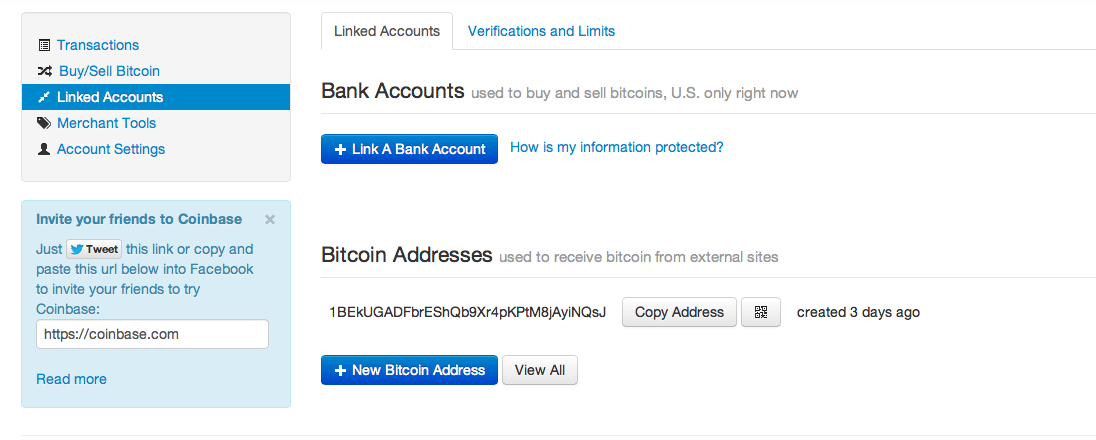
2. Join a pool. To mine in a pool you have to work with a group of other miners on available blocks. The most popular is Slush’s Pool found here. You can also try guilds like BTC Guild as well as a number of other options. Each of the pools is characterized mostly by the fees they charge per block – 2% for Slush’s pool, for example – and the number of users. Pools with fewer users could also have a slower discovery time but pools with many users usually result in smaller payments.
How can you be sure the pool owner doesn’t steal all your bitcoins? You can’t. However, as one pool owner, Slush, notes:
In
theory, as the Bitcoin pool operator, I could keep the 25 BTC from a
block found by the pool for myself. I’m not going to do this, but I
completely accept that people do not trust the pool operator. It is
their freedom of choice, and Bitcoin is about freedom.
For simplicity’s sake, I’m using Slush’s Pool and have created three
workers. First, create a pool login. Then add workers. The workers are
sub-accounts with their own passwords and are usually identified by
[yourlogin].[workername]. I have three workers running, currently – one
on my iMac and two on my old PC.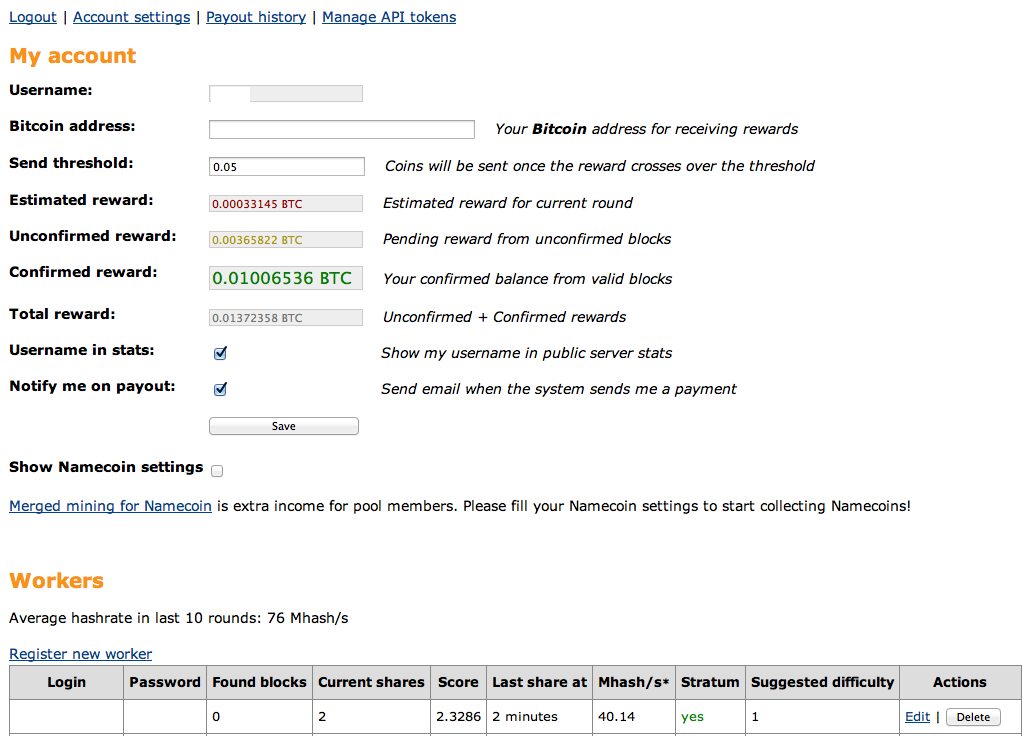
You must create workers to mine. The instructions are very straightforward for most services so don’t become overwhelmed. Like any online club, you can dig deeply into the subculture surround bitcoin as you gain experience. I like to think of it as a financial MMORPG.
Also be sure to enter your wallet address into the pool information. This will ensure you get your bitcoins.
3. Get a miner. There are a number of mining options for multiple platforms although OSX users may find themselves in a bit of a pickle. Miners use spare GPU cycles to power the mining operation, much like services like SETI@Home uses spare cycles for finding intelligent life. Miners, on the other hand, use these cycles to help handle peer-to-peer processes associated with bitcoins. Thus by doing “work” you are maintaining the network as well.
GUIMiner is the simplest solution for Windows users as it allows you to create miners using almost all standard graphics cards. You can download it here. 50Miner is also a popular solution. Both require you to enter your worker info and pool and they’ll start mining.
Linux users can run miners like CGMiner. An excellent guide to installing a miner on Ubuntu is available here.
OS X users can use DiabloMiner, a two-year old command-line program that will mine using OpenCL. Sadly, it uses deprecated calls to Bitcoin and is quite a bit slower. As a result, you need to run your own proxy, Stratum, that allows Diablo to connect with services like Slush’s pool. Both of these programs usually run without issue on OS X although you may need to install OpenCL for OSX.
To mine I’ve created a script that I run in Terminal that simply runs the proxy in the background and then connects Diablo. Note the last two arguments are necessary for Mountain Lion.
./stratum-mining-proxy-master/mining_proxy.py &
./DiabloMiner-OSX.sh -u WORKERNAME -p WORKERPASSWORD -o localhost -r 8332 -w 64 -na
RPCMiner
is far easier to run – you simply click an icon and enter some data –
and both have very rudimentary, text-based interfaces. Running Diablo on
my iMac has not had much effect on application performance under OS X
although it does slow down my Windows 8 machine considerably../DiabloMiner-OSX.sh -u WORKERNAME -p WORKERPASSWORD -o localhost -r 8332 -w 64 -na
4. Keep your mind on your money. Bitcoins are baffling in that they are wildly simple to use and mine. Speculators, then, would probably be able to throw hundreds of machines at the problem and gather bitcoins like raindrops, right? Wrong. As more bitcoins are found, they become more difficult to find. This profitability calculator will help you understand what you’re up against but understand that this isn’t a sure thing. I’ve run my systems for a weekend and seen a mere $1.50 – enough for a coke – but other users may have improved hardware and methods to succeed. In short, if it costs more to run your hardware than you gain in bitcoins, you’re probably doing something wrong.
Good luck in your journey and enjoy your first foray into this wild and wooly world.
Subscribe to:
Posts
(
Atom
)